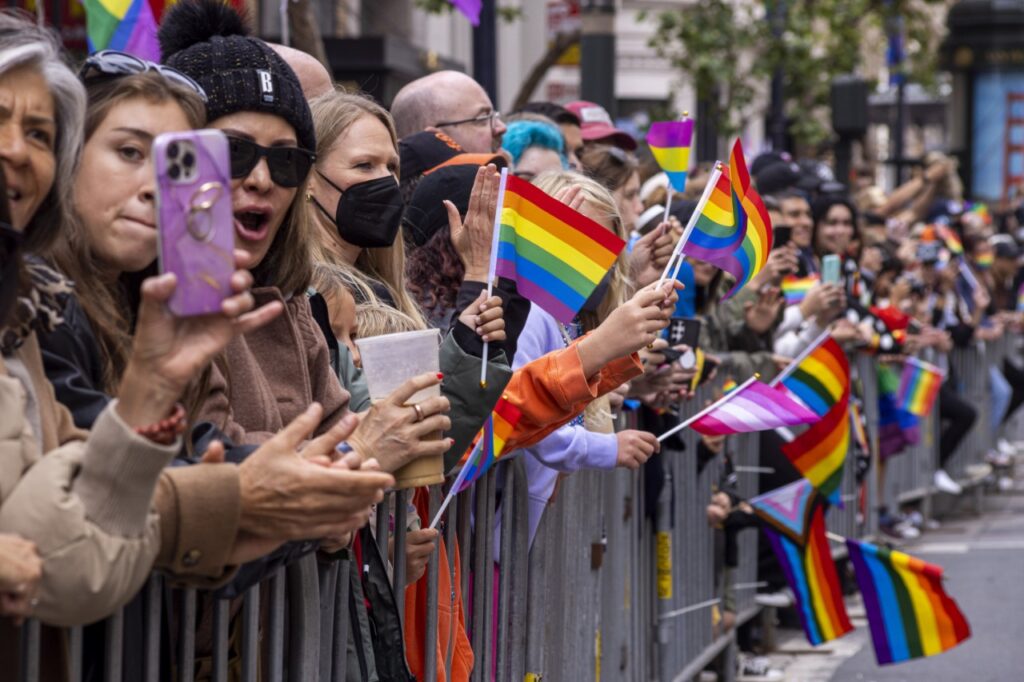
Crowds cheer as marchers cheer during the SF Pride Parade on Market Street in San Francisco, California, June 26, 2022. (Harika Maddala/ Bay City News / Catchlight Local)
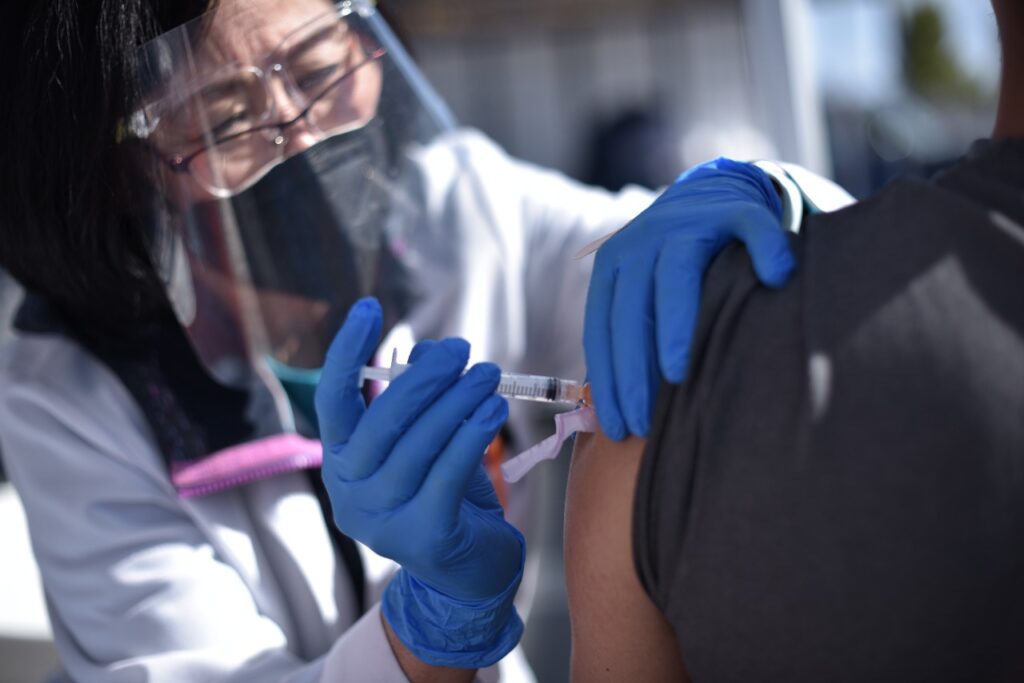
Oakland will receive an additional 2,400 doses of the monkeypox vaccine ahead of the city's Pride and Pridefest events, federal officials said this week.
According to the White House, the number of doses administered during both events will be replenished from California's vaccine stockpile.
Federal and state officials also plan to coordinate to disseminate educational information on how to prevent and treat the virus to Oakland Pride and Pridefest attendees.
Supply of the two-dose Jynneos vaccine for smallpox and monkeypox continues to lag behind demand, but federal officials said this week the country is close to having enough vaccine to immunize 1.6 million people who are most at risk from the virus.
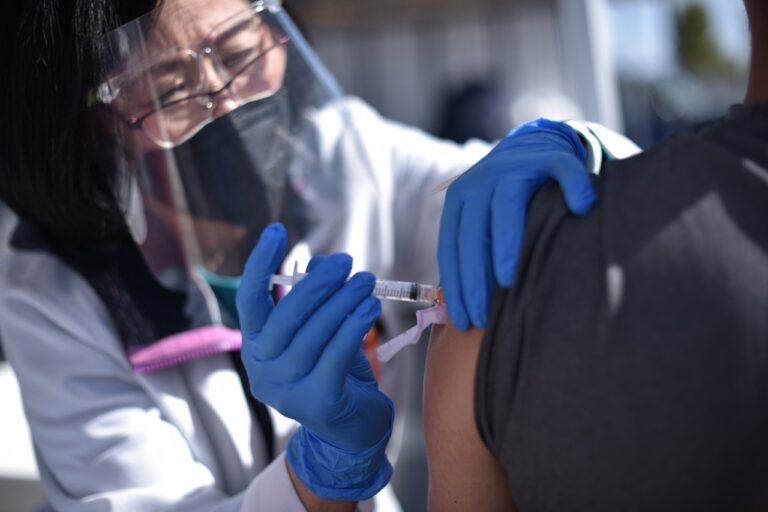
Federal regulators last month gave approval to administer the monkeypox vaccine just beneath the surface of the skin instead of the standard vaccination method that involves an injection into muscle or fatty tissue.
State and federal public health officials have suggested that intradermal vaccines will provide monkeypox-like immunity and expand the number of vaccine doses available by a factor of five, because intradermal injections require only one-fifth the dose needed for administration into a person's shoulder or other muscle tissue.
Oakland Pride is scheduled for this Sunday, while Pridefest will take place on September 11.
Las clínicas comunitarias de vacunas contra el COVID-19 del San Mateo County Health Department ‒SMCH, por sus siglas en inglés‒ están cerradas temporalmente y se espera que vuelvan a abrir después del 12 de septiembre, cuando ofrecerán la nueva vacuna de refuerzo.
This was noted by the county itself in a statement, pointing out that with the recent authorization by the Food and Drug Administration (FDA) and the Centers for Disease Control and Prevention (CDC) of the new bivalent Omicron booster, current monovalent COVID-19 vaccines are no longer authorized for use as boosters.
Diseñadas para la cepa original de la enfermedad, las vacunas actuales contra el COVID-19 solo se pueden administrar como una serie primaria a personas que no han recibido una vacuna.
Las vacunas de refuerzo actualizadas, de Pfizer-BioNTech y Moderna, ofrecen protección contra la cepa original y las variantes de Ómicron, incluidas BA.4 y BA.5, que actualmente causan la mayoría de los casos de COVID-19 en EE. UU. y se prevé que estás sean las que circulen este otoño e invierno.
El refuerzo de Pfizer-BioNTech está disponible para personas mayores de 12 años, mientras que el de Moderna es para mayores de 18 años. Ambos refuerzos actualizados reemplazan las dosis de refuerzo anteriores y deben administrarse al menos dos meses después de una vacunación anterior.
Las vacunas actuales contra el COVID-19 siguen estando ampliamente disponibles, por lo que las personas interesadas en programar sus primeras citas de vacunación ‒serie primaria‒ deben comunicarse con su proveedor de atención médica o una farmacia local.
Se espera que las clínicas de vacunación comunitaria de County Health vuelvan a abrir la semana del 12 de septiembre y ofrezcan los refuerzos actualizados, así como las dosis primarias originales.
Cabe resaltar que los refuerzos actualizados también están disponibles a través de los principales proveedores de atención médica.
«Estamos trabajando para asegurarnos de que los residentes tengan acceso a las nuevas vacunas de refuerzo cuando estén disponibles y para reabrir las clínicas lo antes posible», dijo Lizelle Lirio de Luna, directora de Servicios de Salud Familiar.
A través de un tuit y una entrada a su blog, Twitter anunció que la función más esperada y solicitada por sus usuarios al fin se encuentra a prueba, se trata del botón «editar tuit».
if you see an edited Tweet it's because we're testing the edit button
La red social detalló que los usuarios podrán editar un tuit hasta 30 minutos después de haya sido publicado, y que éste aparecerá con un ícono, una marca de tiempo y una etiqueta, con la finalidad de que todos los usuarios identifiquen cuando un tuit ha sido modificado.
Además, se podrá visualizar el historial de versiones de dicho tuit.
Por el momento la función solo está disponible para un pequeño grupo de prueba que ayudará a identificar la manera en que los usuarios aprovechan esta función y verificar que no se haga un mal uso de ésta, como cambiar el sentido original del tuit.
Twitter también señaló que a finales de este mes los primeros en poder acceder a esta función serán los suscriptores de «Twitter Blue», la versión de pago de la red social y cuyo precio actual es de 4.99 dólares mensuales, mismo que solo está disponible para usuarios en Estados Unidos, Canadá, Australia y Nueva Zelanda.
Pero, no pierdas la esperanza, ya que Twitter subrayó que solo se trata de un «acceso temprano» por lo que posteriormente el botón de editar tuit podría estar disponible para todos.
Editar tuit, una función controversial
Fue desde el abril pasado que Twitter anunció que se encontraban en pruebas para que editar tuit fuera posible para los usuarios de Twitter Blue, luego de que Elon Musk lanzara una encuesta a sus seguidores para saber si les gustaría tener la función de editar.
Sin embargo, la misma red social enfatizó que la decisión de añadir este botón no era resultado de ninguna encuesta.
Durante esas fechas, Musk también había anunciado la intención de adquirir la compañía por 44 mil millones de dólares, pero meses más tarde retiró su oferta tras argumentar que se habían producido violaciones al acuerdo de adquisición.
Tras este hecho, Twitter levantó una demanda contra Musk, en la que lo acusó de «criticar a la empresa, alterar sus operaciones y destrozar el valor para los accionistas».
No obstante, el multimillonario también ha acusado a la red social de no cumplir con su parte del acuerdo, ya que las recientes demandas de un ex empleado de Twitter le han servido para señalar que no se le informó sobre vulnerabilidades flagrantes en la infraestructura de seguridad y protección de datos de la compañía.
On August 22, the Redwood City Council unanimously appointed Elmer Martinez Saballos to serve on the Redwood City Council for District 4 through December 2024.
Prior to his appointment to the City Council, Martinez served on the Planning Commission and as co-president of the Palm Park and Stambaugh-Heller Neighborhood Associations.
Martinez will serve the remainder of the unexpired term due to the vacancy declared following the resignation of former Councilmember Michael Smith in July 2022.
“I am rooted in this community and deeply interested in how our city addresses local and regional challenges that impact residents, ensuring all voices are represented,” Martinez said.
“I will continue to work to elevate those voices and use my experiences to be an effective and thoughtful addition to the city’s leadership,” she said.
Martinez is a lifelong resident of Redwood City and serves as a senior policy associate for ReadyNation, a national nonprofit that mobilizes business leaders to advocate in the state legislature for policies and programs that support children and youth, the city said in a statement.
Martinez previously served as a district representative for former state Sen. Jerry Hill and state Assemblyman Kevin Mullin, where she directly helped constituents navigate state government resources during the COVID-19 pandemic.
In addition to his professional duties, Martinez has volunteered with the Redwood City Education Foundation, Cañada College's OYE Youth Conference and is a graduate of the Chamber's San Mateo County Leadership Program.
It should be noted that a reception has already been scheduled to welcome Councillor Martínez.
Additionally, a ceremonial swearing-in will take place at the next City Council meeting, which will be held in the City Council Chambers on Sept. 12. This will be Martinez’s first meeting as a City Council member.
Beginning Wednesday, extreme heat will be experienced in California and the Western U.S. that will strain the grid with increased demand for energy. In response, Governor Gavin Newsom declared a state of emergency to temporarily increase energy production and reduce demand.
The California Independent System Operator issued a Flex Alert yesterday, August 31, asking Californians to reduce their electricity usage between 4:00 p.m. and 9:00 p.m. to save energy and reduce the risk of blackouts.
Actions the state has taken to accelerate the transition to clean energy have brought approximately 4,000 megawatts of capacity onto the grid that were not available in July 2020. Since then, California has also developed emergency measures including adding generators and a Strategic Energy Reserve, additional procurement, and demand response to produce 2,000 megawatts available to respond to emergency conditions like the one currently facing.
However, as this heat wave is affecting the entire western United States, limited energy resources are being stretched thin across several states.
The prolonged drought has also greatly reduced the state's ability to generate hydroelectric power. Additionally, the duration of this heat wave is unlike any experienced in recent history, increasing the time the grid will face peak demand, the state said in a statement.
“This is just the latest reminder of how real the climate crisis is and how it is impacting the everyday lives of Californians,” Governor Newsom said.
"While we are taking steps to overcome the immediate crisis, this reinforces the need for urgent action to end our dependence on fossil fuels that are destroying our climate and making these heatwaves hotter and more common," he stressed.
The emergency proclamation will allow power plants to generate additional electricity and use backup generators to reduce the amount of energy they need to draw from the grid during periods of peak energy demand during this heat wave.
It also allows ships in California ports to reduce their electricity consumption from the grid.
The government said these are temporary emergency measures, and the state will implement additional mitigation measures to counteract the increase in emissions they will cause.
Temperatures are forecast to begin rising beginning Wednesday, August 31, intensifying over the holiday weekend and extending into Wednesday, September 7.
This will likely be a record-breaking heat wave in the West, with temperatures in Northern California expected to be 10 to 20 degrees warmer than normal, while temperatures in the southern part of the state are expected to be 10 to 18 degrees higher than usual.
The California Independent System Operator is calling on Californians to reduce their energy use through Flex Alert today, and will likely issue additional Flex Alerts in the coming days.
For the coming week, and especially on Sundays and Mondays, Californians should use their air conditioning to pre-cool their homes before 4 p.m. and use major appliances such as washers and dryers during this period.
From 4 p.m. to 9 p.m., Californians must set their thermostat to 78 degrees or higher, avoid using large appliances and turn off unnecessary lights unless it is unsafe for them to do so.
Today’s action comes amid climate-driven shifts in weather patterns across the Western United States, making heat waves more frequent and severe, impacting public health and critical infrastructure.
Extreme heat especially endangers workers, children, seniors, historically underserved and overburdened communities, and people with underlying health conditions.
It should be noted that severe heat is dangerous for everyone and can be fatal, especially when extreme temperatures last more than a couple of days. Factors that increase risk include older age, chronic and serious illnesses, and environmental overexposure – for example, certain jobs or homelessness.
The government is calling on all those caring for someone at higher risk to keep in regular contact with that person, ensure they can access air-conditioned buildings such as cooling centres and public buildings, and keep them hydrated.
In the event of heat stroke, it is important to call 911 if necessary, wear lightweight, light-colored, loose-fitting clothing, use sunscreen, and try to be less active during the hottest part of the day.
Remember to protect your pets from the heat and never leave a child or pet in the car, even if the windows are partially open.
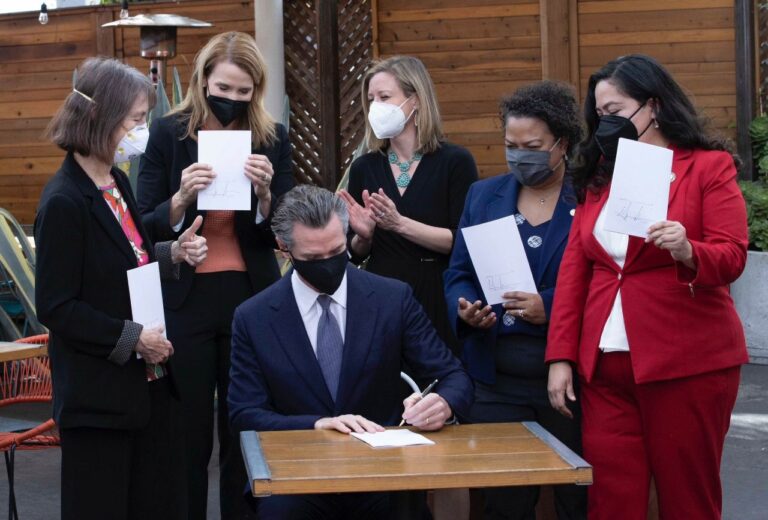
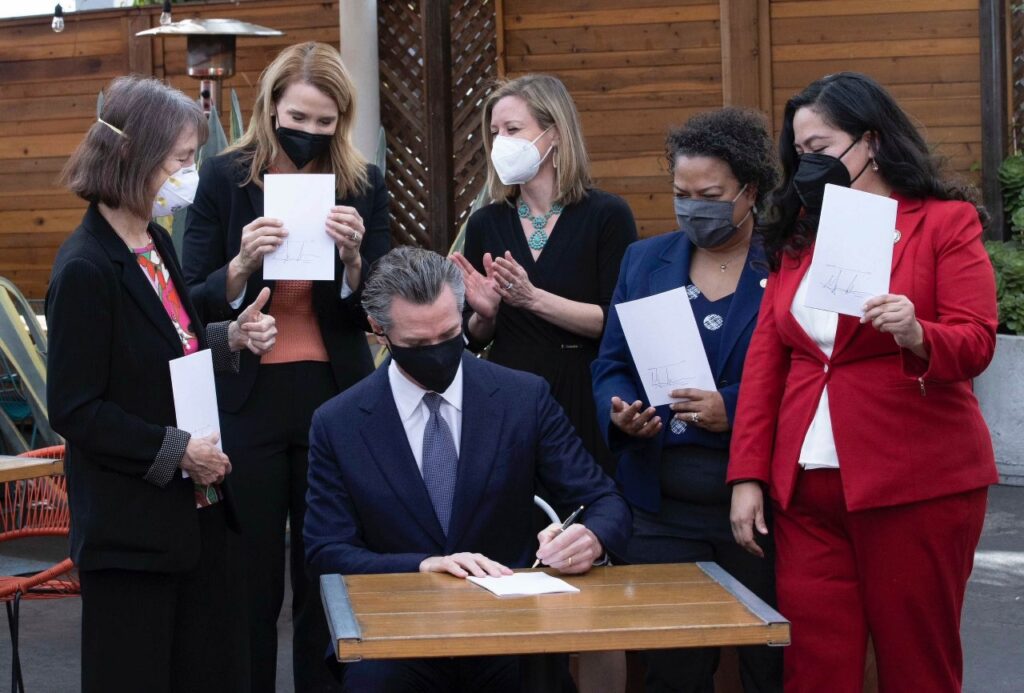
El gobernador de California, Newsom, firma la extensión de la licencia por enfermedad pagada y el alivio de COVID para las pequeñas empresas mientras visitaba el BackYard de NIDO en Oakland, California, el 9 de febrero de 2022. Foto: Oficina del gobernador de California.
State lawmakers this week approved an extension of COVID's paid sick leave, keeping it intact through the end of December.
Los funcionarios estatales aprobaron por última vez una extensión de la licencia pagada para los trabajadores de tiempo completo en febrero, requiriendo que las empresas con más de 25 empleados brinden al menos 40 horas de licencia por enfermedad de manera remunerada a los trabajadores que se infectan o cuidan a otra persona enferma por el virus SARS-CoV-2.
Los trabajadores que presenten prueba de su prueba COVID positiva son elegibles para 40 horas adicionales de licencia pagada. El requisito se aplica a todos los trabajadores que hayan contraído el virus desde el 30 de septiembre de 2021.
El requisito de licencia pagada estaba programado para el 30 de septiembre de 2022, pero ahora vencerá el 31 de diciembre de 2022, ello si el gobernador Gavin Newsom firma el proyecto de ley que incluye su extensión.
Los líderes laborales estatales aplaudieron la aprobación del proyecto de ley por parte de la legislatura e instaron a Newsom a firmar la extensión.
«Mientras los trabajadores de California luchan contra la crisis de asequibilidad al mismo tiempo que la transmisión de COVID-19 continúa ocurriendo comúnmente en los lugares de trabajo, las escuelas y los espacios públicos, estamos agradecidos de ver a la legislatura extender esta red de seguridad a las familias cuando sus sostén económico se ven marginados por infección», señaló en un comunicado la secretaria ejecutiva y tesorera de la Federación Laboral de California, Lorena González Fletcher.
The city of Millbrae is looking for a new logo for its 75th anniversary and has launched a contest for any resident with an artistic spirit to participate.
The new design may be used on the City's website, social media, business cards, letterhead, posters, souvenir merchandise and gifts, or anywhere else the City decides.
The best logos will be selected by a panel comprised of the 75th Edition Community Subcommittee and presented to the community for a voting poll to determine the top three choices.
Following the community survey, the three best proposals will be presented to the City Council, which will vote on the final logo.
It is important to note that the applications will be evaluated based on their visual appeal, their adherence to the concept that motivated the competition, the quality of the design and the ease of reproduction for the purposes indicated above.
The winner will be notified by email and announced on the Town of Millbrae website and social media channels.
The contest runs from 00:01 on August 30th Pacific Standard Time (PST) and closes at 17:00 on September 30th, so late submissions will not be considered.
All applications must be submitted electronically to PIO@ci.millbrae.ca.us., and must include the full name of the person(s) who designed the logo, name, email address, postal address and telephone number.
It should be noted that the City accepts one or more submissions per person, however, each submission must be sent in a separate email.
Logo design guidelines and parameters
Among the rules to follow for the design of the logo, it must include the name "Millbrae" or use the capital letter "M" in the design.
Additionally, it must have “75th Anniversary” or the numbers “75” incorporated into the logo.
The logo should be appropriate for a professional business environment, and entries should be submitted as JPEG files.
It is important to note that submissions must be original work, not copied from others or previous designs, including your own, and not violate the intellectual property rights of any other person or entity.
Submissions become the exclusive property of the City of Millbrae and may be used for City purposes, including, but not limited to, display on websites, business cards, letterhead, posters and other materials.
In that regard, the City of Millbrae clarified that it will have the right to adapt, edit, modify or otherwise use the winning submission in part or in whole in any manner it deems appropriate.
The Mayor of San Francisco, London Breed, noted that the city expects tourism recovery in San Francisco to increase to 21.5 million visitors, which is 26.5 percent more than in 2021.
That, he said, is largely due to conventions at the Moscone Center, which hosted 33 events this year, compared with five last year.
A través de su cuenta de Twitter, precisó que la semana pasada, la Convención Gainsight Pulse atrajo a a San Francisco a dos mil 500 líderes empresariales de todo el mundo, y esta semana la Convención Explore trae a 10 mil asistentes adicionales a la ciudad, mientras que la convención Dreamforce llegará en septiembre, todo en el Moscone Center.
En ese sentido, destacó que 2023 luce un panorama aún mejor, pues ya hay un gran número de habitaciones reservadas.
«El próximo año parece aún más fuerte. Las habitaciones de hotel bloqueadas para eventos en Moscone en 2023 ya han aumentado más del 90 por ciento en comparación con 2022, con más de 630 mil pernoctaciones para visitantes de la convención. Esta es una gran noticia para nuestros restaurantes, pequeñas empresas y trabajadores de la hostelería», precisó.
Sin embargo, refirió que el trabajo en el sector turístico aún debe ser impulsado a través de embajadores, limpieza y seguridad.
«Incluso con este trabajo, seguimos presionando», puntualizó.
En ese sentido, apuntó que el Fondo de Recuperación Moscone de 4 millones de dólares, ofrece incentivos para que las convenciones elijan San Francisco. «Estamos invirtiendo en embajadores, limpieza de calles y contratando más policías para mantener nuestras calles limpias y seguras».
«San Francisco tiene mucho para ofrecer, desde cenar en nuestros restaurantes y visitar nuestros museos de clase mundial, hasta montar en el teleférico y disfrutar de nuestros increíbles parques frente al mar. Estamos emocionados de ver a los visitantes regresar y seguiremos trabajando para que se sientan bienvenidos», finalizó.
De acuerdo con la Asociación de Viajes de San Francisco, la organización oficial de marketing de destino de la Ciudad y el Condado de San Francisco, en 2021 se reportaron 14.8 millones de visitantes a la ciudad, un 25 por ciento más que en 2020, pero un 44 por ciento menos que un récord de 26.2 millones de visitantes en 2019.
En tanto que el gasto total de los visitantes aumentó a 3 mil 100 millones de dólares, mientras que en 2020 fue de 2 mil 800 millones de dólares. Sin embargo, disminuyó un 70 por ciento en comparación con los 10 mil 300 millones reportados en 2019, incluido el gasto en reuniones y convenciones.
«Si bien vimos algunas mejoras en 2021 con el regreso de los viajeros de placer nacionales, las llegadas generales se vieron afectadas negativamente por las restricciones de viaje globales y la variante delta», dijo Joe D’Alessandro, presidente y director ejecutivo de San Francisco Travel en ese momento.
«Nuestra recuperación es más lenta porque dependemos desproporcionadamente de las reuniones, los viajes de negocios y los viajeros internacionales. Antes de COVID, los visitantes internacionales representaban más del 60 por ciento de todo el gasto de los visitantes que pernoctaban, aunque representaban solo el 28 por ciento de nuestros visitantes», abundó en la Conferencia de Marketing anual celebrada el año pasado en el Museo de Arte Moderno de San Francisco ‒SFMOMA‒ en 2021.
Así, ese mismo año, San Francisco recibió a 481 mil visitantes internacionales, un 4 por ciento menos que en 2020 y un 84 por ciento menos que los 2.9 millones de 2019.
Los visitantes internacionales representaron el 11 por ciento del volumen de visitantes que pernoctaron, pero el 44 por ciento de todo el gasto de los visitantes que pernoctaron en 2021. Ellos, gastaron mil millones de dólares, un 2 por ciento más que los 985 millones de dólares de 2020, pero un 80 por ciento menos que los 5 mil 100 millones de dólares de 2019.
Los cinco principales mercados internacionales por volumen de visitantes en 2021 fueron México, India, Canadá, Países Bajos y Taiwán. En tanto que, los cinco principales mercados para el gasto de visitantes internacionales en 2021 fueron México, India, Canadá, Taiwán y Países Bajos.
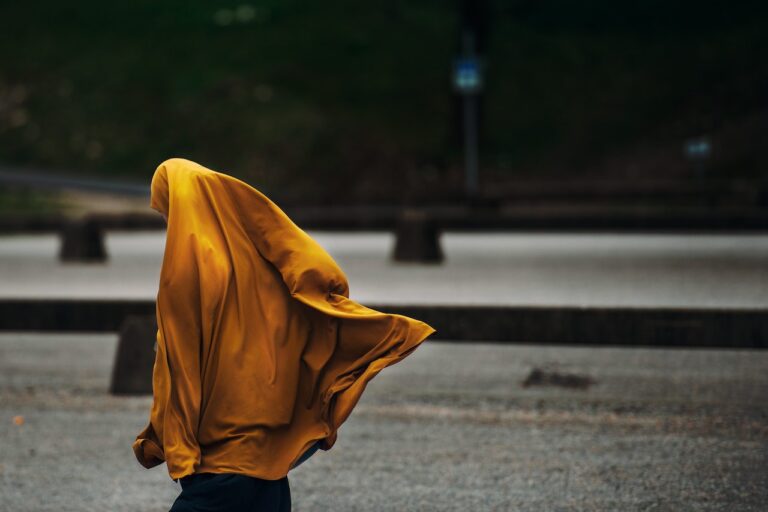
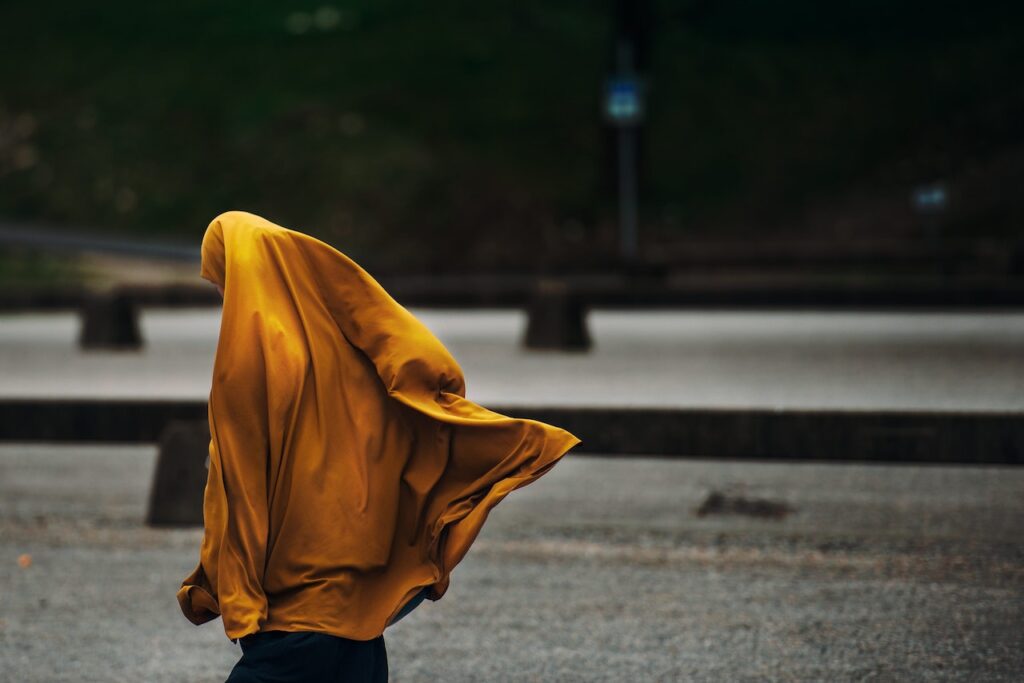
A 43-year-old woman has been charged with a hate crime and assault in Mountain View after attacking a teenage girl wearing a hijab and calling the young woman a “terrorist.”
The unprovoked attack by bystander Atoosa Biglari occurred in broad daylight in downtown Mountain View, Santa Clara County, where two women who witnessed the attack rushed to the victim's aid.
Police arrested Biglari, who fled the scene on a bicycle. The attacker will be arraigned Tuesday afternoon in Palo Alto County Courthouse Department 85. She faces more than a year in county jail if convicted on all three charges.
"We have no tolerance for those whose intolerance crosses the line into criminality and violence," the prosecutor said. Jeff Rosen“Hate has no place in Santa Clara County. We also commend the bravery of the two women who quickly stepped forward to help the victim. They are wonderful examples of the national anti-hate campaign motto: ‘If you see something, say something.’”
The hate crime occurred on July 1, shortly after 3 p.m., when police were dispatched to Castro and Mercy streets, the Santa Clara County District Attorney's Office said in a statement.
She added that the 18-year-old victim was walking alone on Castro Street when Biglari crossed the street, shouted at her, accused her of "hacking" and then called her a "terrorist," after which the attacker began pulling the victim's hijab and then pushing her against the wall and putting her hands on her neck.
The victim called for help and the two women who witnessed the attack corroborated the victim's account, stating that they saw Biglari on the road.
Biglari also faces charges of brandishing a deadly weapon in a rude, angry and threatening manner, stemming from a previous incident on June 24, 2022, in which he threatened another woman with scissors.
This publication was supported in whole or in part by funding provided by the State of California, administered by the California State Library.
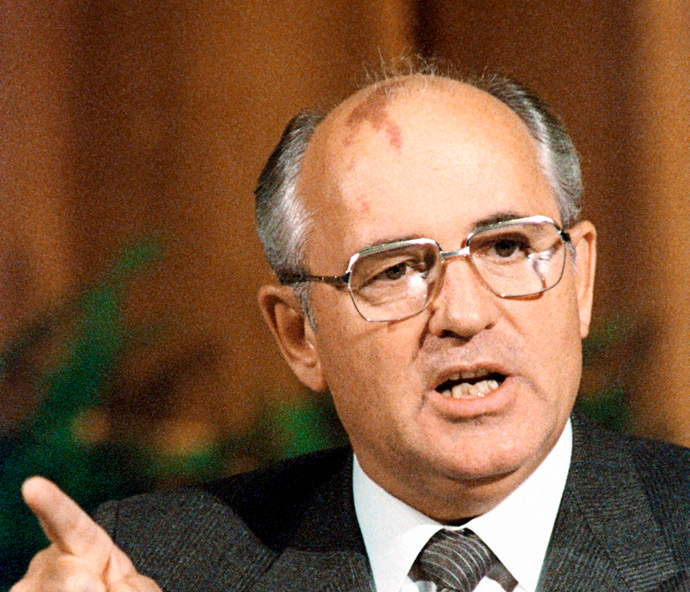
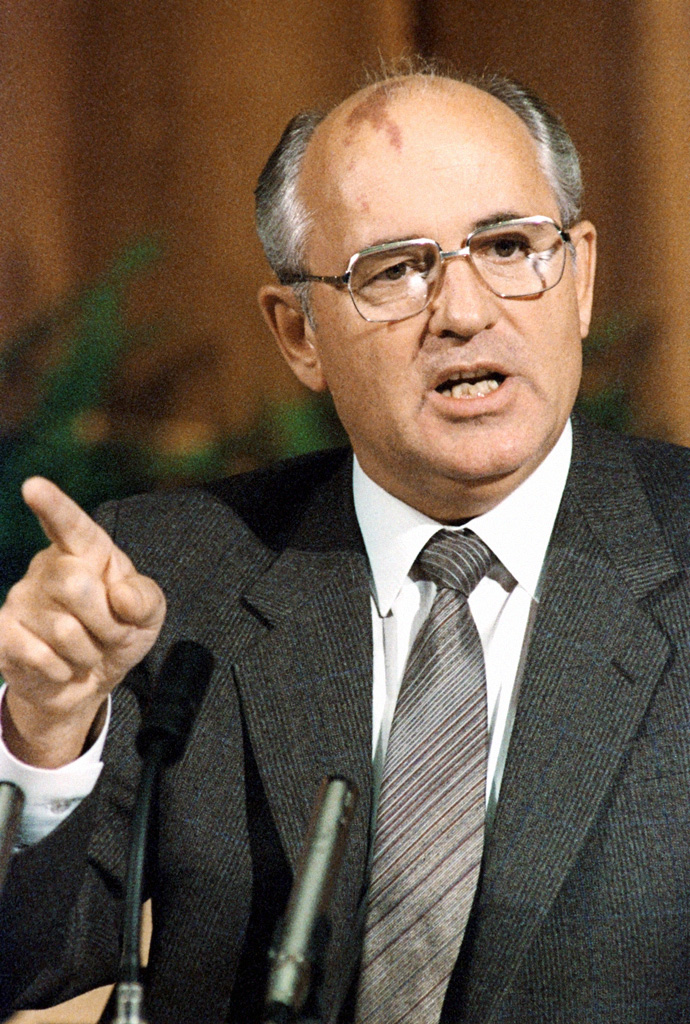
Former Soviet leader Mikhail Gorbachev died on Tuesday, August 30, in Moscow at the age of 91, Russian media reported.
Gorbachev, who served as a Russian lawyer and politician, has died, according to statements from the Central Clinical Hospital (TSKB, in Russian), the hospital where the last president of the Soviet Union was hospitalized, who died "after a long serious illness."
The former Soviet leader, born on March 2, 1931 in Privolnoye, Russia, graduated from the Faculty of Law of Moscow State University and led the Soviet Union –USSR– between 1985 and 1991, implementing the Glastnost and Perestroika reforms, which sought greater transparency and restructuring, as well as the internal democratization of the party.
In 1990, he was awarded the Nobel Peace Prize for reaching an agreement with leaders Margaret Thatcher (United Kingdom) and Ronald Reagan (United States) that helped end the Cold War.
Gorbachev resigned as leader of the USSR on December 21, 1991, following the dissolution agreement with Ukraine and Belarus, at the same time as the USSR dissolved. Despite the changes he was a part of and the recognition he had in many parts of the world, he was blamed for the end of the Soviet Union.
Thus, at 90 years of age and after living away from the media due to health problems, Mikhail Gorbachev acknowledged in an interview that he did not think of using force to keep the USSR united, since the country was already full of nuclear weapons.
It is worth noting that Gorbachev was one of the main critics of Vladimir Putin, President of Russia, as he denounced corruption on several occasions and even called for the Russian leader to resign.
Nevertheless, Gorbachev won international acclaim and was awarded the Nobel Peace Prize in October 1990 for his role in ending the Cold War and reunifying Germany.
His remains will be buried at Moscow's Novodevichy Cemetery, which contains the graves of his wife and other prominent Russian figures, according to Russian news agency TASS.
European Commission President Ursula Von Der Leyen expressed her condolences on Twitter: “Mikhail Gorbachev was a trusted and respected leader. He played a crucial role in ending the Cold War and bringing down the Iron Curtain. He paved the way for a free Europe. It is a legacy we will not forget. RIP Mikhail Gorbachev.”
According to the Interfax news agency, Vladimir Putin himself expressed "his deepest condolences on the death of Gorbachev," said his spokesman, Dmitry Peskov.