Get your gloves, buckets, and reusable water bottles ready! San Mateo County is looking for volunteers for Coastal Cleanup Day 2022 this September.
There are two ways to participate in the annual litter cleanup event on San Mateo's shorelines.
The first is to join the main event on Saturday, September 17 from 9 a.m. to noon: San Mateo County will host more than 50 cleanup sites led by Space Captains with thousands of volunteers gathering in groups to remove trash before it breaks down into smaller pieces, harms wildlife, or ends up in our waterways.
But if you can't join the main event on September 17, you'll be able to join the Cleanup throughout the month.
The county reminds you that you can still make a difference right outside your door. “Gather your family and friends, go alone or bring your dog and pick up litter in your neighborhood throughout September.”
Those interested in getting involved to help beautify and protect their community, and be inspired by other volunteers, can sign up at www.smchealth.org/ccd to find a location near you.
There are over 30 cleanup locations to choose from throughout the county.
If you are interested in becoming a site captain or know of a location that would make a good cleanup site, you can contact the Pollution Prevention Program at (650) 388-2096 or email: pollutionprevention@smcgov.org.
The Governor Gavin Newsom announced more than $317 million in federal support for seven jurisdictions that continue to recover and rebuild after federally declared disasters in 2018, when wildfires burned more than 1.6 million acres and destroyed hundreds of homes and businesses, particularly in the town of Paradise in Butte County.
The Community Development Block Grant-Disaster Recovery (CDBG-DR) funds announced last Friday are for critical infrastructure projects that must be completed as communities work to build and rebuild needed housing, especially for low- and moderate-income people, and ensure that every household displaced in these disasters has the opportunity to return home.
“California remains committed to uplifting and supporting all communities impacted by the devastating wildfires as they work to rebuild,” Governor Newsom said.
She added that rebuilding after communities are tragically destroyed due to extreme weather “is an opportunity to restore economic opportunities and strengthen communities by giving them a chance to heal.”
In August 2018, the Carr Fire and Mendocino Complex Fire broke out in Northern California, followed in November 2018 by the Camp and Woolsey Fires. These were the most destructive and deadly wildfires to hit California that year. In total, more than 1.6 million acres burned during 2018.
“We are inspired by residents who are coming together and working in partnership with the state to rebuild their lives, restore economic opportunities, and create a more resilient future,” said Lourdes Castro Ramirez, Secretary of the Housing, Consumer and Business Services Agency.
“These dollars represent an important milestone for communities that endured unimaginable tragedy due to these devastating wildfires. We will continue to work closely with our federal partners in the Biden Administration to get resources to communities more quickly and equitably when disasters strike,” she stressed.
The California government detailed in a statement that communities received funds based on their unmet infrastructure needs and have the flexibility to use the grants to support projects based on their priorities to rebuild in a safe, sustainable and resilient manner.
The Town of Paradise received nearly $200 million, which will be used to build critical projects that will accelerate its ability to rebuild higher-density, more affordable housing, commercial corridors, and critical evacuation routes should it face future disasters.
“Rebuilding together is the foundation of the ongoing recovery effort in the Town of Paradise,” said Gustavo Velasquez, Director of the California Department of Housing and Community Development. “This nearly $200 million award will support critical infrastructure for the Town as it rebuilds with resilience and climate mitigation at the heart of its goals. We remain committed to supporting the residents of Paradise as they recover and rebuild.”
CDBG-DR funds are administered by HCD after receiving a federal allocation from the U.S. Department of Housing and Urban Development (HUD).
Among the prizes announced Friday were: Butte County at $72,072,679.61; City of Chico at $12,388,409.65; City of Malibu at $47,276.93; City of Redding at $22,563,043.51; City of Lake Shasta at $1,326,184.69; Los Angeles County at $3,788,157.86; and Pueblo of Paradise at $199,592,735.75. Those figures total $317,428,488.
Anualmente se realizan más de 500 mil vasectomías en EE. UU., sin embargo, hombres de las comunidad latina y afrodescendiente, son las que con menor frecuencia deciden realizarse una vasectomía o esterilización quirúrgica para la anticoncepción, dejando así una mayor responsabilidad a la mujer en cuanto a la reproducción sexual.
The fact is that, according to a study publicado por los Institutos Nacionales de Salud ‒NIH, por sus siglas en inglés‒, detallan que el 11.4 por ciento de los hombres de 30 a 45 años informaron haberse hecho una vasectomía, lo que representa aproximadamente 3.6 millones de hombres estadounidenses.
Sin embargo, detalla que 14.1 por ciento de los hombres blancos se sometieron a una vasectomía, mientras que solo el 3.7 por ciento de los hombres afrodescendientes y el 4.5 por ciento de los hombres hispanos reportaron haberse realizado este procedimiento para el control natal.
Dichos números, cabe resaltar, no dependieron de la demografía, pareja y factores socioeconómicos. Pero, el hecho de haber estado casado alguna vez, ser padre de dos o más hijos, la edad avanzada y los ingresos más altos se asociaron con la vasectomía.
«Después de tener en cuenta el historial reproductivo, la pareja y las características demográficas, los hombres negros e hispanos tenían menos probabilidades de depender de la vasectomía para la anticoncepción. Se necesita más investigación para identificar las razones de estas diferencias raciales/étnicas y para identificar los factores que impiden que los hombres pertenecientes a minorías dependan de este medio de control de la fertilidad», detalló el documento.
La seguridad y la eficacia hacen de la vasectomía una buena opción de planificación familiar, pero los factores relacionados con el uso de la esterilización quirúrgica masculina pueden ser variadas.
El auge de la anticoncepción en los países desarrollados se produjo en la década de 1960 gracias a la revolución sexual. La participación de los hombres en la planificación familiar apareció en la Conferencia Internacional sobre Población y Desarrollo de 1994, que tenía como objetivo fomentar un papel igualitario en el control de la natalidad.
«Desafortunadamente, la participación masculina en la anticoncepción es muy limitada debido a las posturas y miedo a una reducción de su hombría, virilidad y destreza sexual, así como la ignorancia de los beneficios de la anticoncepción para los hombres», señalaron los autores.
La vasectomía fue utilizada inicialmente por sus efectos sobre la próstata, luego como rejuvenecimiento quirúrgico masculino y, finalmente, como anticonceptivo. Para 1973, el doctor Li Shuguang desarrolló la vasectomía sin bisturí para reducir el temor de los hombres al procedimiento.
A nivel mundial, hay 37 millones de hombres que eligieron la vasectomía, principalmente en países desarrollados.
«Las razones por las que la vasectomía no es tan preferida en los países en desarrollo tienen que ver con los miedos que son principalmente de naturaleza sexual, que se basan en el desconocimiento del procedimiento, así como en pensar que la anticoncepción es solo para mujeres y que es mejor si ellas se operan», precisaron.
Organizaciones médicas urológicas y de obstetricia, han detallado que la vasectomía es más segura, más sencilla, menos costosa e igual de eficaz que la esterilización femenina, sin embargo, es uno de los métodos anticonceptivos menos utilizados.
Ante ello, precisan que la esterilización femenina es aproximadamente dos veces más común que la vasectomía en países desarrollados, 8 veces más común en Asia y 15 veces más común en América Latina y el Caribe.
La vasectomía es más común que la esterilización femenina en sólo cinco países: Bután, Canadá, Países Bajos, Nueva Zelanda y Gran Bretaña.
En Bután, la vasectomía es 8 veces más común que la esterilización femenina; en Gran Bretaña, casi 3 veces más común; en Canadá y los Países Bajos, el doble; y en Nueva Zelanda, aproximadamente un tercio más común.
El uso de la vasectomía en el mundo varía significativamente según la región y el país. En los países desarrollados, menos del 5 por ciento de las parejas recurren a la vasectomía. En los países en desarrollo, la prevalencia global de la vasectomía es del 2.5 por ciento.
La prevalencia supera el 10 por ciento en ocho países: Australia, Bután, Canadá, los Países Bajos, Nueva Zelanda, la República de Corea, Gran Bretaña y los Estados Unidos.
En Bután, aproximadamente el 40 por ciento de las parejas que recurren a la vasectomía son anticonceptivas, la proporción más alta del mundo; seguida por Nueva Zelanda, con aproximadamente el 25 por ciento, luego Canadá, el Reino Unido y Estados Unidos, con aproximadamente el 20 por ciento cada uno, mientras que Australia y la República de Corea, con el 12.5 por ciento cada uno.
Asia, con una prevalencia del 3 por ciento, representa aproximadamente las tres cuartas partes de los 32 millones de parejas de todo el mundo que recurren a la vasectomía: sólo China y la India suman 20 millones de usuarios.
En América Latina y el Caribe la prevalencia de la vasectomía es sólo del 2 por ciento. Puerto Rico tiene la tasa más alta de la región, un 5.3 por ciento. En el África subsahariana, menos de una décima parte del 1 por ciento de las mujeres casadas confían en la vasectomía de su pareja como método anticonceptivo.
After Roe v. Wade
A raíz de la decisión de la Corte Suprema de poner fin a Roe v. Wade, cada vez más hombres están tomando el control de la natalidad en sus propias manos. Lo están haciendo recurriendo a la vasectomía para evitar embarazos no deseados, señaló la cadena de noticias CBS.
Precisó que solo un día después de que el fallo entró en vigencia, las búsquedas en Google de la palabra «vasectomía» alcanzaron su punto máximo y los médicos de todo el país están recibiendo llamadas de hombres que preguntan sobre el procedimiento.
De acuerdo con la organización Planned Parenthood, la vasectomía puede costar hasta mil dólares, lo que incluye las citas de seguimiento.
El costo de una vasectomía varía y depende de dónde te la hagan, del tipo de vasectomía y si tienes un seguro médico que cubra una parte o todo el costo.
La vasectomía puede ser totalmente gratuita (o de bajo costo) con algunos planes de seguro médico, Medicaid y otros programas del gobierno.
Aunque al comienzo una vasectomía cuesta más que otros métodos, en general suele ayudarte a ahorrar dinero a largo plazo, pues dura para siempre.
También, la vasectomía cuesta 6 veces menos que la esterilización femenina ‒también conocida como ligadura de trompas‒.
Hate speech is becoming more and more evident in the country. Hate attacks against the AAPI community (Asian-American and Pacific Islander) are on the rise in the United States. The Stop AAPI Hate initiative recorded more than 11,000 hate incidents against these communities.
Hate crimes, said Becky L. Monroe, deputy director for Strategic Initiatives and External Affairs, at a press conference organized by Ethnic Media Services, are considered by the California Department of Civil Rights –CRD– as “a criminal act committed because of disability, gender, nationality, race or ethnicity, religion, sexual orientation or because of the association of a person with another or a group of people.”
The CRD also noted that it considers "an expression or action that may be motivated by race, color, disability, religion, origin, sexual orientation or gender and that may or may not violate the law" to be a hate incident.
According to federal data from the Federal Bureau of Investigation’s (FBI) annual Hate Crimes Statistics Act report, the number of hate crimes against the AAPI community increased more than 73 percent from 2008 to 2020.
In addition, the National Crime Victimization Survey (NCVS) indicated that this year the number of hate crimes exceeds 200,000 per year, which has worried members of this community and activists. "There is no doubt that the numbers are misreported," Monroe acknowledged.
Brian Levin, a criminologist and civil rights attorney, said hate crimes increase during election time because "there is a connection to politics," he said.
He also noted that according to the Center for the Study of Hate and Extremism (CSHE), hate crimes against the Latino community increased by 41 percent, while those directed at the African-American community increased by 46 percent.
"Most hate crimes are committed by white men," Monroe said, adding that a large number of the reported incidents included hateful, racist and xenophobic rhetoric used by former US President Donald Trump.
In her turn, Manjusha P. Kulkarni, executive director of the Asia-Pacific Policy and Planning Council (A3PCON), pointed out that most acts of hate against the AAPI community occur in public places such as parks or businesses, 61 percent of these have been against women, 9.9 percent against minors under 17 years of age and 7 percent against older adults.
Since the beginning of the COVID-19 pandemic, anti-China discourses have gained strength around the world, blaming this country for the pandemic derived from the SARS-CoV-2 virus, which caused an increase in attacks against this sector, interrupting and affecting their daily lives due to fear and concern, as the incidents even occurred in schools.
“Many of the acts that happen in schools are hate incidents” and can amount to crimes, Monroe said. As a result of the pandemic, a large number of Asian school-aged children were physically and verbally attacked under the slogan “go back to your country.”
Kulkarni also noted that 63 percent of the attacks are in the form of verbal harassment, while 16.2 percent are physical attacks. “Most of these are traumatic and damaging, but they are not hate crimes,” she said.
Thus, since they are not considered as such, the solutions for these incidents are not limited to the application of the law alone.
Derived from this problem and thanks to the coalition of organizations such as the Department of Asian American Studies at San Francisco State University, Chinese for Affirmative Action and AAPI Equity Alliance ‒formerly the Asian Pacific Policy & Planning Council‒ Stop AAPI Hate was born, which seeks to monitor and respond to hate incidents against these communities.
This organization seeks, among other things, to advocate for local, state, and national policies that protect the rights of AAPI communities.
Additionally, the California Department of Social Services and the Commission on Asian American and Pacific Islander Affairs (CDSS and CAPIAA) announced that the Stop the Hate program would provide $20 million in fiscal year 2021-22 to support and care for victims of hate crimes and incidents, as well as prevent them.
"We hope that policymakers will look at this issue and determine what we need in terms of government responses because community organizations cannot do this alone," Kulkarni said.
Healing and fighting hatred
"My grandmother had a breathing tube down her throat, she had blood all over her, and we found her in the middle of a slide, having been harassed by a 17-year-old boy who is now being charged with murder," said Sasanna Yee, a conscious movement instructor and community wellness activist in San Francisco.
Following this event, Yee created the initiative “Move the Chi for Multiracial Solidarity” which seeks to foster unity and collective action against all forms of hatred and violence, through a healing practice that has its origins in China.
"My grandmother has started teaching me to go beyond cultural barriers," she said.
“How do we create a world that is more humane?” Yee asked, noting that each of us has the power to transform circumstances.
At the end of the meeting, the experts agreed on the need for communities to join forces to fight against hate attacks and thus achieve a more just country for all. They also called for reporting hate incidents and crimes, as they stressed that the numbers "are higher than we imagine."
They also pointed out the importance of creating spaces to understand the type of hatred towards this sector through education, the application of laws in favour of civil rights and the visibility of this problem with the help of the media, politicians and leaders.
If you suffer any incident or hate crime, you can report it through https://stopaapihate.org/reportincident/, if you need immediate assistance, please call 911.
This publication was supported in whole or in part by funding provided by the State of California, administered by the California State Library.
La tasa de desempleo en California cayó a niveles históricamente bajos en julio, al tiempo que agregó la mayor ganancia de empleos del estado desde febrero y la segunda más grande desde agosto de 2021.
«Los californianos están volviendo a trabajar con un desempleo bajo récord», señaló el gobernador Gavin Newsom. «Tenemos reservas históricas y estamos devolviendo dinero a los bolsillos de las personas a medida que continuamos liderando la recuperación económica de la nación».
A través de un comunicado, el gobierno estatal detalló que la cantidad de californianos empleados aumentó por séptimo mes consecutivo.
Así, California agregó 84 mil 800 empleos no agrícolas y el sector privado logró una recuperación total de la recesión inducida por la pandemia.
En julio, la tasa de desempleo de California cayó del 0.3 por ciento para colocarse en al 3.9 por ciento, estableciendo un nuevo mínimo histórico que se remonta a la serie de datos oficiales que comenzó en 1976.
La tasa de desempleo también cayó por debajo del nivel anterior a la pandemia del 4.1 por ciento en febrero de 2020 y la cantidad de californianos desempleados cayó en julio a su punto más bajo en los últimos 33 años.
California agregó 84 mil 800 empleos no agrícolas en julio, la mayor creación de empleos del estado desde febrero y la segunda desde agosto de 2021, lo que eleva el empleo no agrícola total en el estado a 17 millones 618 mil 100 empleos.
El estado representó el 16.1 por ciento de los nuevos puestos de trabajo de la nación en julio.
Asimismo, California ha recuperado todos los empleos del sector privado perdidos durante la recesión inducida por la pandemia.
El número de californianos empleados aumentó en 23 mil, el séptimo mes consecutivo de aumento de empleo en el estado.
En lo que va del año, California ha creado 477 mil 600 ‒14.5 por ciento‒ de los 3 millones 296 mil nuevos puestos de trabajo del país.
Celina Rodríguez chose her profession as a journalist at a young age, a job she has practiced for more than thirty years and with which she has broken borders to support the migrant community in the San Francisco Bay Area.
That is why, and because of his extensive experience in both Mexican and American media, he knows that "no one has the right to extinguish your dreams."
There are several ways to practice a profession and one of them is commitment. Celina Rodríguez has been practicing journalism perhaps since before she even knew it, when instead of following rules that dictated that women should not dedicate themselves to that type of work, she chose to follow her instinct and enroll in the degree in Communication Sciences at ITESO of the Jesuit University of Guadalajara.
Since then, she has tirelessly established herself for more than 17 years within the Bay Area community as one of the journalists most committed to the well-being of the Latino and migrant society, promoting services for access to housing, health and social welfare among people who have difficulties due to the English language.
In an interview with Peninsula 360 Press during the segment “Portraits of the Bay Area,” she says that one of her dreams has always been to be a microphone to give a voice to the silenced; a feat she has carried out not only through journalism, but also through Stanford’s Journalism program, John Knight Fellowship for Professional Journalists.
Celina Rodríguez also has a prolific career in journalism in Mexico. newssystem and in California in print, radio and television. She was also one of the founders of the San Francisco newspaper "El Mensajero Newspaper" as well as the first Mexican news anchor in the Bay Area with the "newscast 48» from KSTS and long-time news anchor on CNN en Español.
She currently works as a journalist from her own company, which allows her to freely select her coverage, which she broadcasts from her most famous program, "Interview with Celina" through two radio programs, Facebook, Instagram and YouTube.
For more details about Celina Rodriguez and her journalistic work visit the interview on the Instagram account of @peninsula360press.
Here's the news you need to know to stay up to date on local news from August 15-20, 2022.
‒ 0 ‒
Mandarin immersion students from the Redwood City School District (RCSD) demonstrated their fluency and confidence in the Asian language in the final round of the China Bridge Competition in the United States.
The award-winning students put what they have learned in the Mandarin Immersion Program to use by participating in the national competition organized by the Chinese Consulate of San Francisco this June, showcasing their linguistic and cultural talents. A second-grade student from Orion Elementary School took third place nationally, while two other students from the same school received honorable mentions.
‒ 0 ‒
After being discontinued for years, the North Fair Oaks Festival has once again become a meeting point to celebrate a resilient community that has its sights set on the future and the vitality of a neighborhood that has become home to a large Latino community.
The meeting was at ten in the morning at 2510 Middlefield Road, in front of the North Fair Oaks Library, where the cities of Redwood City, Menlo Park and Atherton come together to accommodate a large Latino community that celebrated its space for five hours once again.
‒ 0 ‒
With the support of members of the Assembly and the mayor herself, Chris Sturken is running for a seat on the Redwood City Council, after announcing his run on Tuesday to keep his hometown a safe, livable and affordable community.
Through her social media, she detailed that her priorities are maintaining a safe and vibrant downtown, ending homelessness and creating more affordable housing.
‒ 0 ‒
On Wednesday, the San Mateo County Mayors’ Mental Health Initiative announced a $250,000 investment from the Chan Zuckerberg Initiative, a fund advised by the Silicon Valley Community Foundation, to support increased access to mental health resources throughout the community.
The investment will support three nonprofit organizations: Star Vista, Daly City Youth Health Center, and the ONE LIFE program through OneLife Counseling.
‒ 0 ‒
San Mateo County will begin repairing cracked and rough pavement along a series of roads between Highways 1 and 35 ‒Skyline Boulevard‒ beginning Monday, August 29.
The project will improve road surfaces in San Mateo County, but will cause short-term delays and inconveniences for bicyclists. This is the 15th year of the county’s “chip seal” road maintenance program, a proven, cost-effective method that improves surfaces and causes less disruption to the traveling public than other treatments.
The project involves 50 miles of county-maintained roads. Beginning Monday, August 29, work will begin on Sunshine Valley Road, then move to Higgins Canyon Road and Purisima Creek Road.
‒ 0 ‒
Parents were notified via SMS about a shooting in Hoover Park in Redwood City on the afternoon of Friday, August 19.
The official version of the authorities is that, according to a witness who was at the scene, two adult men were apparently having an argument in the center of the grass field, after which one of them took out a gun, pointed it at his opponent and fired several times, the subjects then fled the area where some children were with their parents.
Following the initial report to authorities, staff at The Boys & Girls Club called police to report that two of the windows in the vicinity were hit by bullets. Staff at the location confirmed that no one was injured by the gunfire, but that one of their employees was injured by one of the broken windows.
‒ 0 ‒
The San Mateo County Office of Arts and Culture wants to know what healthy community images should decorate a popular trail for a mural project in North Fair Oaks.
The city is conducting a survey that will help influence a mural located along the Fifth Avenue pedestrian walkway that runs under the Caltrain tracks. The mural will have 16 separate panels.
The survey can be completed online or in print until September 30, 2022.
‒ 0 ‒
San Mateo County has moved to the “low” or “green” COVID-19 community level, meaning case rates and hospitalizations are declining.
Overall, COVID-19 cases, driven by the Omicron variant, remain high compared to previous periods and local health officials continue to recommend caution.
In the Bay Area, San Mateo, Marin, Sonoma, San Francisco and Alameda counties are also in the low or green community tier.
The head of a colossal statue of Ramesses II, featured in the deYoung Museum’s new exhibition, “Ramesses the Great and the Gold of the Pharaohs,” opening Aug. 20, 2022. (Olivia Wynkoop / Bay City News)
We're just over halfway through August, and the Bay Area is filled with events to enjoy with family, friends, or alone. So get your pen and paper ready because these are some of the events happening in San Mateo County, San Francisco, and surrounding cities.
‒ 0 ‒
The 15th Annual Sequoia High School Alumni Association Picnic will be held this Saturday, August 20th from 10:30 a.m. to 3:00 p.m. at Sequoia High School located at 1201 Brewster Avenue in Redwood City.
With this event, the Sequoia High School Alumni Association seeks to raise funds and invites alumni and the general public to participate in the picnic.
There will be a delicious barbecue lunch, campus tours, an open house at the Library and renovated Media Center, performances by the Sequoia Cheerleaders and Choir, and much more.
Tickets are $40 in advance and a limited number of tickets will be available at the door for $45.
For information and/or tickets, call (650) 592-5822, email SHSAA@SequoiaAlumni.org or visit www.SequoiaAlumni.org.
‒ 0 ‒
If you're looking for music, this Saturday will also see the Aurora Mandolin Orchestra Concert, which will perform from 2 to 4 p.m. at the Sandpiper Community Center located at 797 Redwood Shores Parkway in Redwood City.
The Aurora Mandolin Orchestra consists of over 30 members with professional and amateur musicians playing mandolin, mandola, mandocello, guitar, double bass, accordion, flute and percussion. Join them for a wonderful evening filled with music!
The uniqueness of this group is its varied repertoire and creative arrangements of folk music, Italian, Spanish and Russian semi-classical songs, popular oldies, contemporary pieces, excerpts from operas and classical orchestral compositions written specifically for mandolin.
‒ 0 ‒
Kids Rock! Asheba is an event that the little ones in the house cannot miss. This Sunday from 11 a.m. to 1 p.m. the Courthouse Square located at 2200 Broadway Street in Redwood City, will host Asheba, a musical storyteller who specializes in calypso, the oral musical and folkloric tradition of Trinidad, Asheba's homeland.
Stories of hope and happiness are the focus of their songs, which range from original lullabies to up-tempo tunes and remakes of classics such as Itsy Bitsy Spider, Five Little Monkeys, Twinkle Twinkle Little Star and You Are My Sunshine.
Because their music is for all ages, abilities, and backgrounds, you'll find kids and parents alike singing, clapping, and dancing with joy. Your family will be thrilled to enjoy free live music, along with an inflatable play area and more.
‒ 0 ‒
Cover band The Deep Fakes will perform this Sunday from 5:00 to 7:00 p.m. at Marlin Park, located at Neptune Drive and Cringle Drive in Redwood City, as part of the Sounds of the Shores summer festival.
The Deep Fakes is the San Mateo Bay Area's most dynamic four-piece band featuring a team of highly skilled and energetic musicians with a passion for entertainment and a great taste for music.
Their mission is to offer a fun, entertaining and professional-level live music experience, bringing Rock, Pop and Dance hits from the 80s and 90s to the party.
‒ 0 ‒
The deYoung museum will host an international traveling exhibition combining ancient artifacts with cutting-edge technology, called “Ramesses the Great and the Gold of the Pharaohs.”
The exhibit runs from August 20 to February 12, 2023. Tickets are $35 on weekdays or $40 on weekends for adults.
More information about discounted rates for children, seniors and students can be found at deyoungmuseum.org.
Part of the ticket sales will go toward efforts to preserve and excavate ancient artifacts in Egypt, said Egyptian archaeologist and exhibit curator Zahi Hawas, who is also leading efforts to restore Ramses' tomb.
El condado de San Mateo pasa a «verde» lo que quiere decir que se ha movido al nivel comunitario de COVID-19 a «bajo», ya que las tasas de casos y las hospitalizaciones están disminuyendo.
Sin embargo, la medida del jueves de los Centros para el Control y la Prevención de Enfermedades ‒CDC, por sus siglas en inglés‒ no significa el fin de la pandemia, señaló el condado en un comunicado.
Overall, COVID-19 cases, driven by the Omicron variant, remain high compared to previous periods and local health officials continue to recommend caution.
In the Bay Area, San Mateo, Marin, Sonoma, San Francisco and Alameda counties are also in the low or green community tier.
Los CDC enumera los «Niveles comunitarios» para las jurisdicciones de Estados Unidos como una forma para que las personas y los funcionarios decidan las estrategias de prevención en función de la información más reciente.
Para pasar al nivel comunitario bajo de COVID-19, el condado de San Mateo tuvo que cumplir con ciertas métricas establecidas por los CDC, incluidas menos de 10 nuevas admisiones hospitalarias por COVID-19 semanales por cada 100 mil residentes. La tasa más reciente del condado fue 8.7.
Las tasas de casos de COVID-19 también deben descender por debajo de 200 en los últimos siete días; la tasa de casos más reciente es 185.63 en el condado de San Mateo.
El Departamento de Salud del Condado de San Mateo aún recomienda estar al día con las vacunas y los refuerzos, hacerse la prueba si tiene síntomas y usar máscaras de alta calidad como N95 o KN95 en entornos donde la ventilación es deficiente o si tiene un alto riesgo de enfermedad o enfermedad grave.Para estrategias de prevención de COVID-19, un calendario de clínicas de vacunas, paneles de datos y más, los interesados puede visitar la página web de recursos de County Health COVID-19.
Por Karina Alvarado, Anna Lee Mraz Bartra y Manuel Ortiz Escámez
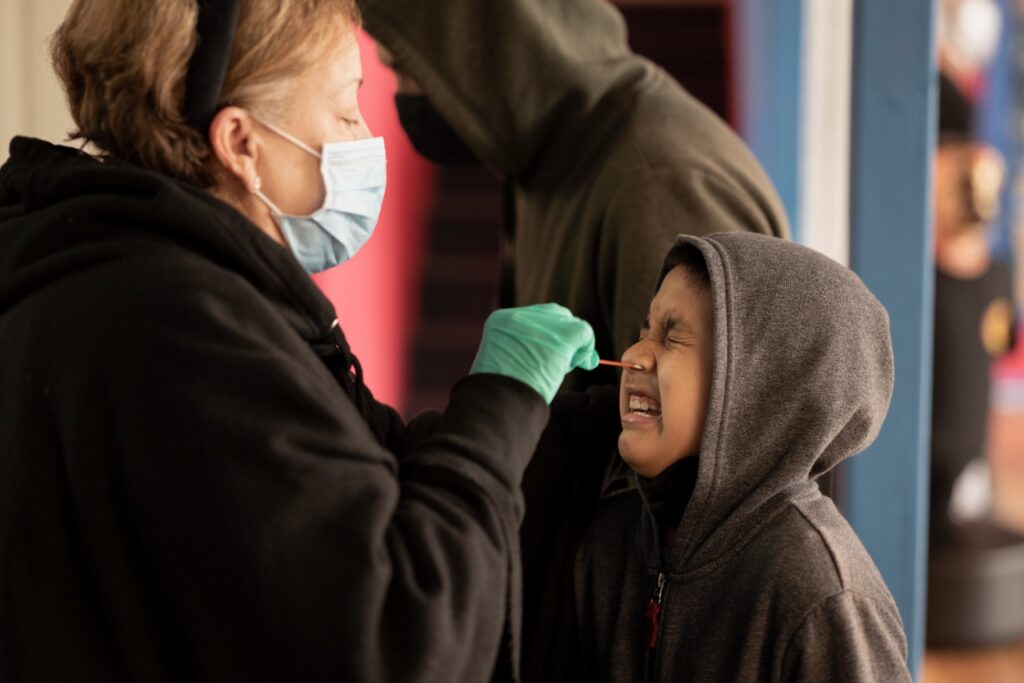
Calexico, California. — La pandemia por COVID-19 afectó a todo el mundo, sin embargo, perjudicó significativamente a los más desfavorecidos.
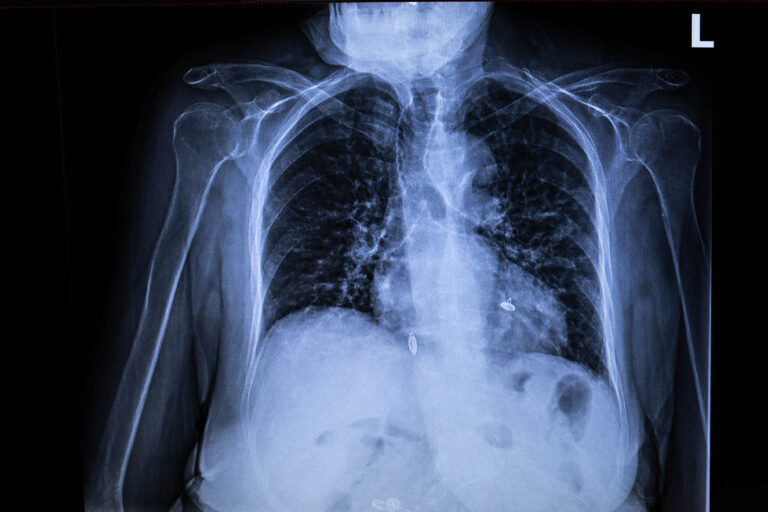
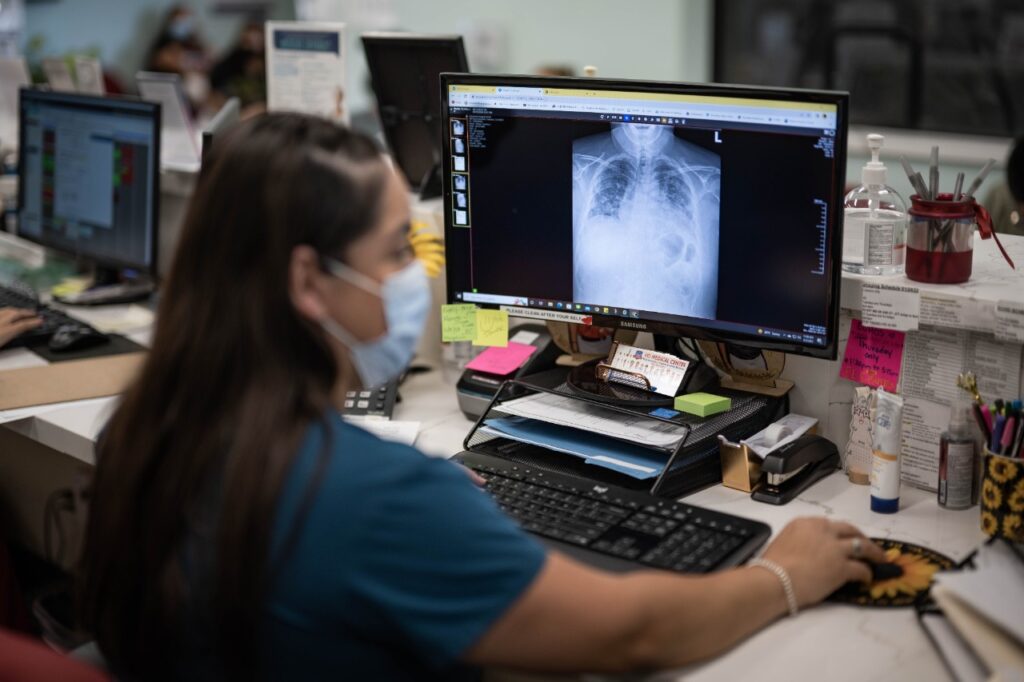
«Tenía un paciente, joven de unos 40 años, sin problemas médicos, sólo obesidad, es decir, con un índice de masa corporal —IMC— arriba de 50 y le dio COVID a principios de 2020 y murió. Es muy triste», relató el doctor Tien Vo de la clínica Vo Medical Center en Calexico, una ciudad fronteriza en el condado Imperial al sur de California.
Imperial County, with a population of about 197,000, is one of the poorest regions in the United States. More than 86 percent of the area's total population is Latino.
Before the pandemic, this region was already suffering from serious health problems, as in addition to being a low-income community, it is located near Lake Salton, a highly toxic place due to pollution.
La polución del aire y del suelo en la región ha provocado que zonas del condado Imperial tengan una de las tasas más altas de asma en infantes, además de altos índices de obesidad y diabetes.
«Otra cosa, muy importante aquí, además de la obesidad, es que hay muchas personas con asma y enfermedades pulmonares obstructivas crónicas. Estamos muy contaminados debido al “Salton Sea” y eso también contribuyó a la alta tasa de mortalidad por COVID», explicó el doctor Vo para Península 360.
Foto de un paciente con COVID-19 en la clínica del doctro Vo, quien explica que en la región «hay muchas personas con asma y enfermedades pulmonares obstructivas crónicas. Estamos muy contaminados debido al “Salton Sea” y eso también contribuyó a la alta tasa de mortalidad por COVID» Foto: Manuel Ortiz Escámez.
Con la llegada de la pandemia por COVID-19, el condado Imperial —que es una región compuesta mayormente por trabajadores agrícolas— fue uno de los más afectados por la enfermedad causada por el virus SARS-CoV-2, provocando una de las tasas más altas en hospitalización y mortalidad del país.
Al ser una ciudad fronteriza, el valle Imperial recibe a diario a cientos de trabajadores provenientes de México que cruzan la frontera para laborar en los campos agrícolas.
Estos trabajadores, aunque son reconocidos como necesarios para la supervivencia de miles de personas por las organizaciones de la sociedad civil, son grupos que han sido marginados e ignorados por los gobiernos federales y estatales históricamente.
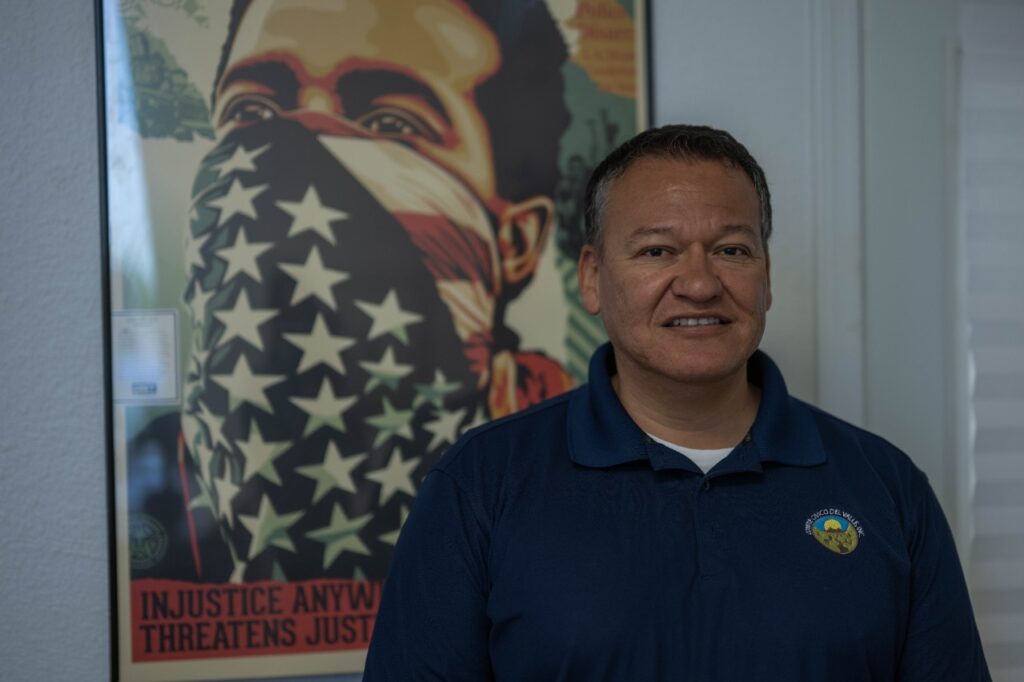
«El presidente Trump nos abandonó», declaró Luis Olmedo, director ejecutivo del Comité Cívico del Valle.
A pesar de que la región fue altamente afectada, las autoridades federales y estatales no le prestaron la debida importancia, abandonando así a las comunidades vulnerables que viven en esa área.
Este abandono no solo trajo incertidumbre a las comunidades desfavorecidas del condado, sino que también desencadenó que otras organizaciones y fundaciones cesaran el apoyo.
Cuando comenzó la pandemia por COVID-19, a pesar de que el estado de California tuvo intenciones de trabajar con el Valle Imperial para dar pie a mejoras en temas de salud, tecnología, economía e infraestructura, «los rancheros han controlado la política aquí… ellos quieren gente que no tenga futuro para que sigan levantando la cosecha de esos campos», apuntó Raúl Ureña, vicealcalde de la ciudad de Calexico.
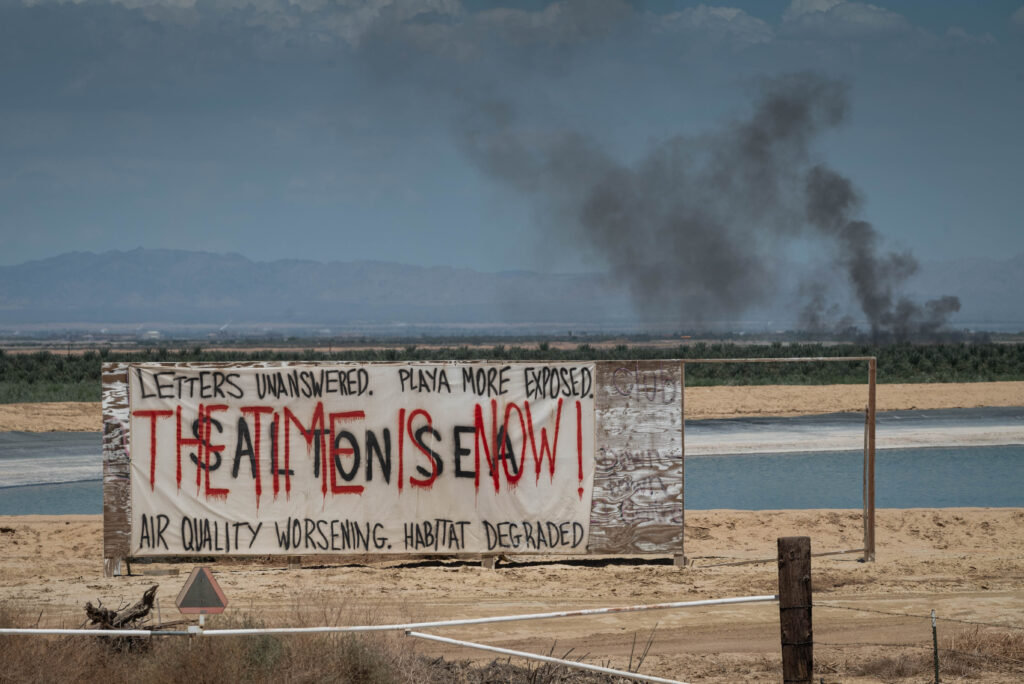
Pinta de protesta por la contaminación en el lago Salton en el condado Imperial. De acuerdo con el vicealcalde de Calexico Raúl Ureña, este condado recibió la menor cantidad de vacunas al ser considerada «zona rural». Foto: Manuel Ortiz Escámez. P360P – Ethnic Media Services.
«Fue evidente que las primeras alocaciones [sic] que hace el estado de California de todos los condados, favorece desproporcionadamente a aquellos con más población y con mayor poder político. Estamos hablando de San Diego, Los Ángeles, San Francisco. No sé cuál fue el pensamiento de los oficiales en Sacramento, pero el Valle Imperial durante casi toda la pandemia tuvo la mayor tasa de mortalidad de casi todo el país», relató Ureña.
«Nos tocó proporcionalmente una burla aquí en Valle Imperial», destacó Ureña quien además señaló que las primeras campañas de vacunación no eran eficientes para las comunidades desfavorecidas, pues los lugares donde estaban ubicadas no tenían acceso a transporte público, además de las barreras tecnológicas y de idioma.
Ureña subrayó que, a nivel estatal, dicha zona recibió una menor cantidad de vacunas por ser considerada «zona rural», sin embargo, destacó que alrededor de 50 mil personas al día cruzan la frontera para trabajar, por lo que fue fundamental considerar la interacción que se tiene, incluso con las ciudades mexicanas.
Luis Olmedo, reconoció que «cuando estaba el presidente Obama hubo mucho apoyo». Asimismo, refirió que esa ayuda fue utilizada para resolver los problemas económicos y de salud de la zona.
Al verse abandonados por las autoridades durante la emergencia por COVID-19, nacieron organizaciones sin fines de lucro como «Salud sin fronteras», mismas que buscan ayudar a las comunidades más desfavorecidas sin tomar una posición política, pues para ellos la prioridad es contribuir a mejorar la calidad de vida de estas poblaciones.
Luis Olmedo, director ejecutivo del Comité Cívico del Valle y fundador fundador de la coalición de organizaciones Salud sin Fronteras, misma que nació ante el abandono de las autoridades a el condado Imperial durante la pandemia por COVID-19 y que hicieron posible que las campañas de vacunación contra el virus comenzaran a ser exitosas. Foto Manuel Ortiz Escámez. P360P – Ethnic Media Services.
Las campañas de vacunación comenzaron a ser exitosas gracias a estos grupos de la sociedad civil, quienes avanzaron estratégicamente en la protección de la población más vulnerable a pesar de las dificultades económicas y de transporte.
Además, combatir la desinformación fue uno de los más grandes retos para las organizaciones sin fines de lucro que buscaban apoyar a las comunidades. Pues, según Olmedo, las preferencias políticas influyeron negativamente en la toma de decisión, ya que los discursos anti-mascarillas y anti-vacunas se expandieron por todo el territorio.
Mitos sobre supuestas afectaciones al corazón, hasta la supuesta implantación de chips por la vacuna contra COVID-19 circulaban prominentemente en el condado Imperial a pesar de que los Centros para el Control y Prevención de Enfermedades —CDC, por sus siglas en inglés— han señalado que dicha información es falsa.
Organizaciones como «Salud sin fronteras» le hicieron frente a la pandemia aún ante dificultades particulares de la región, tal es el caso de las afectaciones de salud debido a la contaminación del aire, del agua y del suelo.
La población de esta región fue blanco de la desinformación, pero para Olmedo, el acceso a la vacuna fue una barrera importante.
«Muchas veces a nuestra comunidad no se le da la decisión», comentó Luis Olmedo en relación con la influencia que tuvieron los mitos en la comunidad para recibir la inoculación contra COVID-19, pues a pesar de que la desinformación ha sido uno de los factores que ha minado la confianza de la gente en la vacuna, al inicio de las campañas de vacunación había pocas oportunidades de recibirla en el condado Imperial.
A los recursos del Estado, focalizados en apoyar a la población ante la emergencia sanitaria, también se sumó el sector filantrópico que comenzó a proveer recursos a organizaciones como «Salud sin fronteras» para crear campañas en los ambos lados de la frontera, de manera que las barreras económicas, tecnológicas y de idioma disminuyeran, creando oportunidades para que las comunidades latinas y de trabajadores agrícolas fueran registradas y posteriormente vacunadas.
Las organizaciones de la sociedad civil fueron clave ante la emergencia por COVID-19 pues apoyaron principalmente a campesinos y otros trabajadores esenciales a través de recursos estatales y federales.
Olmedo reconoció que «con la administración de Joe Biden, de nuevo se abrieron las puertas», de la misma manera, la administración estatal también incrementó los recursos.
Tras el incremento de recursos y las campañas de vacunación extensivas, el racismo en esta parte del país se hizo notar, según relata Ureña, quien escuchó que diversos grupos de personas comenzaron a quejarse debido a que se ofrecían vacunas y apoyo a las personas que diariamente cruzan la frontera o que no tienen residencia estadounidense: «estás dando los recursos de este país a gente que no vive aquí o que no se los merece», decían.
El condado Imperial tuvo el índice de mortalidad más alto por COVID-19 de todo el país y, gracias a la labor de organizaciones de la sociedad civil comprometidas, logró colocarse como uno de los de mayor tasa de vacunación de todo California.
Con la pandemia atenuada, surgen problemáticas aún vigentes que afectan de manera importante la salud y el bienestar de las personas que habitan la zona o que entran desde México para trabajar cosechando para empresas norteamericanas.
Uno de los problemas actuales más importantes es el de la contaminación del Lago Salton.
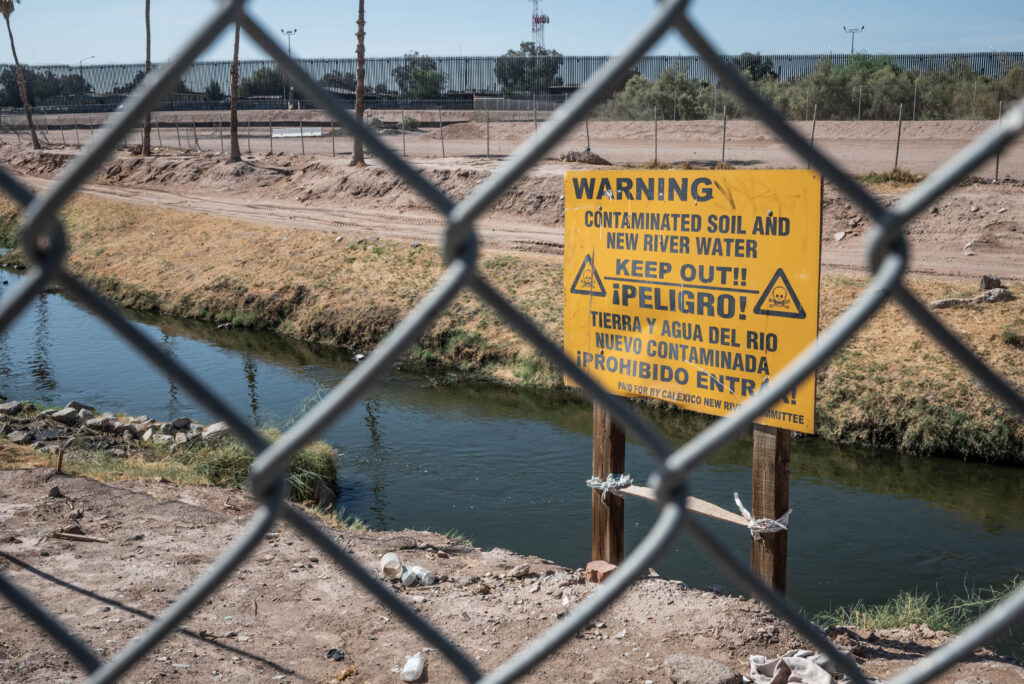
Con una superficie de más de 200 mil acres, este lago es el más grande de California y es alimentado por el río Nuevo que corre desde Mexicali, recorre Calexico y desemboca en Salton Sea.
Este enorme lago es uno de los más contaminados en los Estados Unidos pues recibe enormes descargas de aguas residuales de México. La contaminación y las sequías han levantado la preocupación de trabajadores, funcionarios y organizaciones.
Río Nuevo Calexico en la frontera con Mexicali, este río alimenta al lago Salton, el cual es uno de los más contaminados en los Estados Unidos. Foto Manuel Ortiz Escámez. P360P – Ethnic Media Services.
Salton Lake affects the health of Imperial County residents and workers
«A los campos agrícolas se les aplican pesticidas y químicos muy tóxicos, y se han descargado por más de 100 años en el Lago Salton», señaló Olmedo.
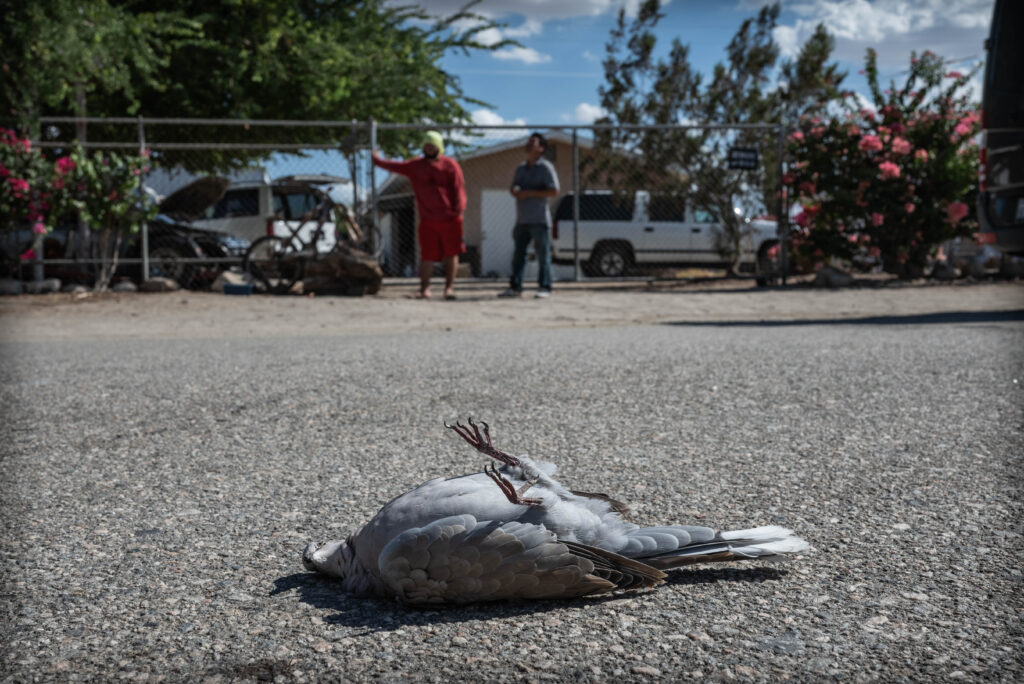
«El mayor lago de California ofrece más de 380 millas cuadradas de actividades recreativas al aire libre, como la navegación, la observación de aves, la acampada y la pesca», anuncia Tripadvisor sobre el Salton Sea. Lo que deja fuera esta descripción es que las aves aparecen muertas a media calle y la pesca está estrictamente prohibida.
Pobladores del condado Imperial, señalaron a P360P que aves que se acercan al lago Salton para tomar agua mueren en los alrededores de éste debido a la contaminación derivada de más de cien años de descargas de pesticidas y químicos tóxicos en dicho lago. Foto Manuel Ortiz Escámez. P360P – Ethnic Media Services.
Lo que alguna vez fue un bello lugar turístico, rodeado de casas de descanso para personas adineradas, ahora es un poblado seco y peligroso. Olmedo advirtió que, de secarse por completo el lago, más de 100 millas alrededor resultarán afectadas en temas de salud y de alimentos, incluyendo Los Ángeles y San Diego, entre otras ciudades, alcanzando estados como Arizona y Nevada.