Wednesday, April 1, 2026
Home Blog Page 463

Participatory democracy

Maritza Leal. Peninsula 360 Press.

Whenever elections are coming up, it is a challenge to reach out not only to our Hispanic community, but also to the skeptics who are already tired of so many unfulfilled promises by elected officials. But what should our reaction be to such circumstances?

Definitely not fainting. Because the right to vote is one of our rights under our Constitution; moreover, it is the way to raise our voice from our trenches and, consequently, send a message to the regime of government - whatever it may be - of our approval or disapproval, that we are watching them to bring about true democracy and the rule of law.

We only have to look at the past, at history, to realize that there were generations of women and the African-American community who dreamed of this right and who, unfortunately, never witnessed it become a reality.

Today we have that right and privilege at our fingertips.

Let us not be satisfied with a representative democracy; rather, let us make the exercise of an authentic participatory democracy a reality, where inclusion is a way of life with responsibility and respect.

Here in Redwood City, we have experienced gentrification, changes in the light industrial zone, changes in the school district, increases in homeless families and coupled with that, the catastrophic effects of the pandemic we are experiencing and heroically facing.

We will definitely not be the same in the immediate future, but it is in us - and only in us - that the definition of our future life lies. Because our future depends, in large part, on what is done or not done, for or against our community. Will we be witnesses to our dreams fading before our eyes, or will we be the protagonists of history? Setting a historical precedent and opening the way for future generations who lack a culture of voting.

If there is one thing I am convinced of, it is that we are sufficiently capable of correcting this imperfect democracy where agendas contrary to our interests have been imposed on us; people like me, who are known in the popular jargon as the ordinary citizen, as a person who does not hold a six-figure salary and who goes out every day to earn his living.

Democracy means the power of the people - "dḗmos" and "krátos". Let's stop with krátos alone and start together on the path to the inclusion of "dḗmos" and thus have the satisfaction of having contributed to the path towards a real participatory democracy, learning more about our local politics, elected officials and future candidates.

Let us honor, then, the efforts of our forefathers; that many of them fought and paid in blood for civil rights, including the right to vote. Let us continue to build the profile of our community and choose who will be in charge of our government and include in their agendas the problems that afflict us a large majority and not a select group.

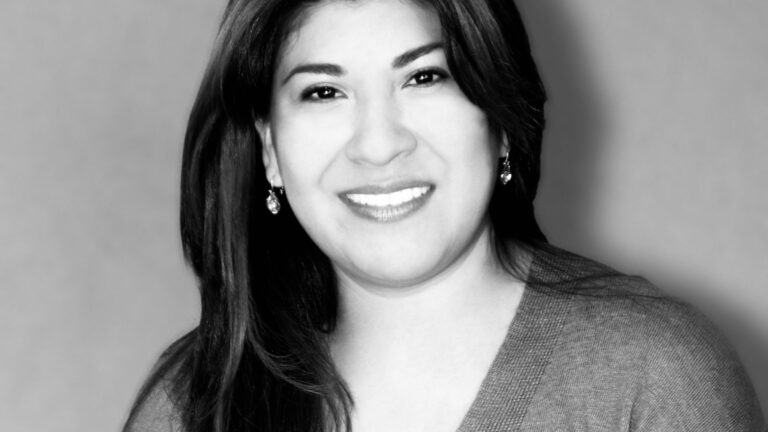
Maritza Leal is a Mexican migrant and activist. She lives in Redwood City.

Tastes like home

Tastes like home 故乡的味道

Listen to the column

Anna Lee Mraz Bartra. Peninsula 360 Press

It's no surprise that one of the seven deadly sins is gluttony. There are few things in life as delicious as the sensations generated by a good meal. 

The sound of cork, popwhich lets out the acidic aroma of wood and earth, anticipates what's to come: glu glu sounds the reddish liquid that honors the name of its color when it escapes from the bottle to crash into the limits of the glass. It rises, falls and bubbles. The aroma, formerly subtle, envelops you. The first drink always generates an explosion of emotions from the palate. The burst runs through your body. 

What do you feel first? It can be quiet, your lungs fill up with air as if the first bite, the first drink, gives you permission to do so after a day's work. It can be relief when your body cries out to fill that hole in your stomach, and you find yourself with something pleasant that surprises you favorably. You may feel a complete repulsion that, in front of others, you hide in a friendly smile. The possibilities are endless with an unknown dish in front of you. It is an adventure. 

Almost every sound, aroma, colour and flavour from the kitchen links to the past, builds on the present or produces dreams of the future. 

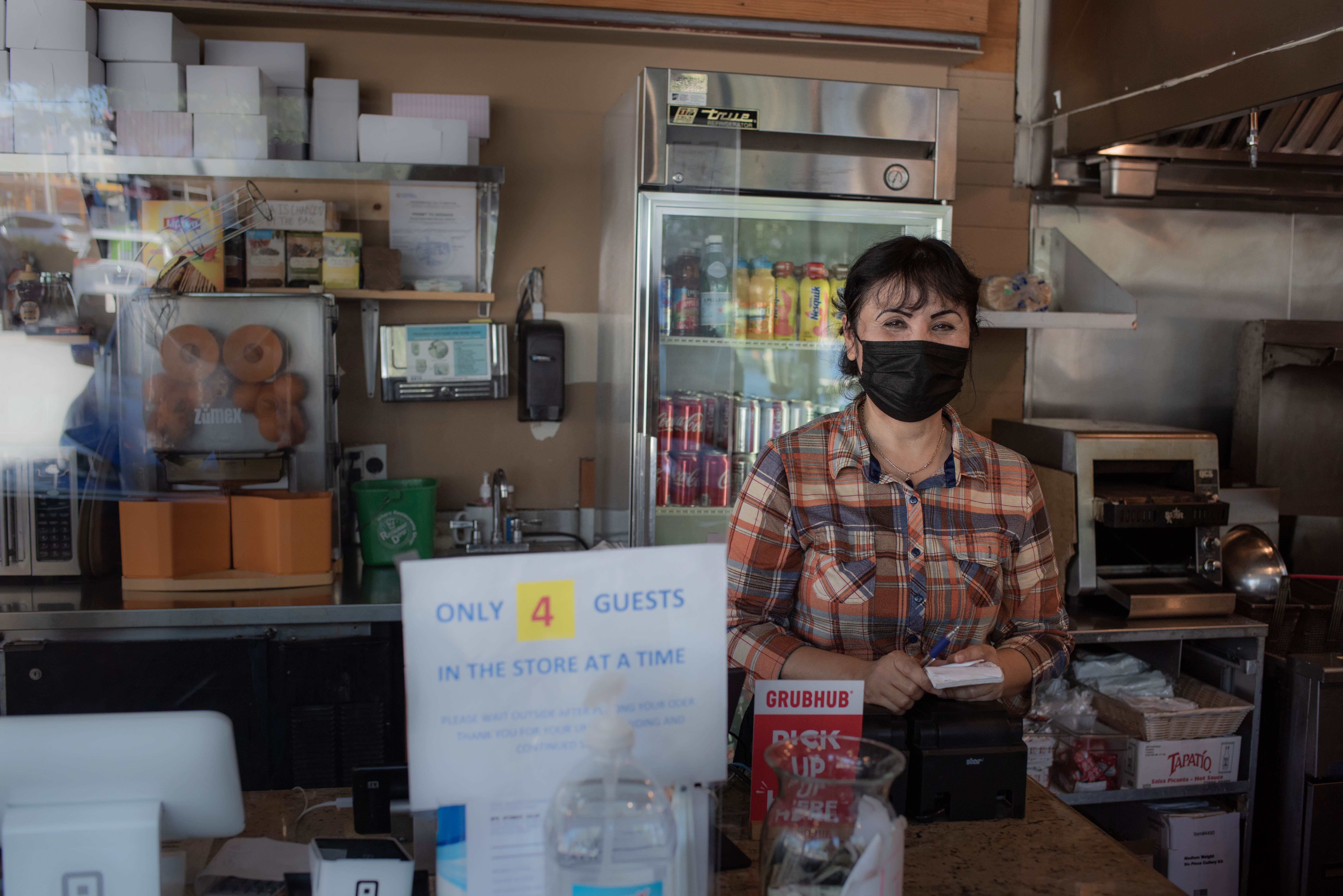
Recently, one morning in a rush to work, I walked into a breakfast and donut restaurant on Veterans Boulevard called Homeskillet. I waited patiently for my turn and while I was doing so, I heard the kitchen talking to each other in Spanish: "Ponlele queso cheddarthe order carries souvenir"I had spoken English with the person who was taking the order, but when I heard this I went over to ask in Spanish "What is the sandwich shown in the picture?" I pointed to the picture. A woman with a genuine smile and an epicanthal fold in her eyes kindly answered me in English.

Melany gladly serves the premises behind the protection glass by COVID. Photo by Manuel Ortiz. Peninsula 360 Press.

The kitchen would be nothing without that clash and syncretism of cultures. The potatoes, which originally came from Peru, saved Europe from famine in the early 20th century. And that morning they accompanied my Omelette sandwich, avocado, bacon and cheese that I was spilling on the edges of the Sourdough bread, proudly produced in the San Francisco Bay Area.

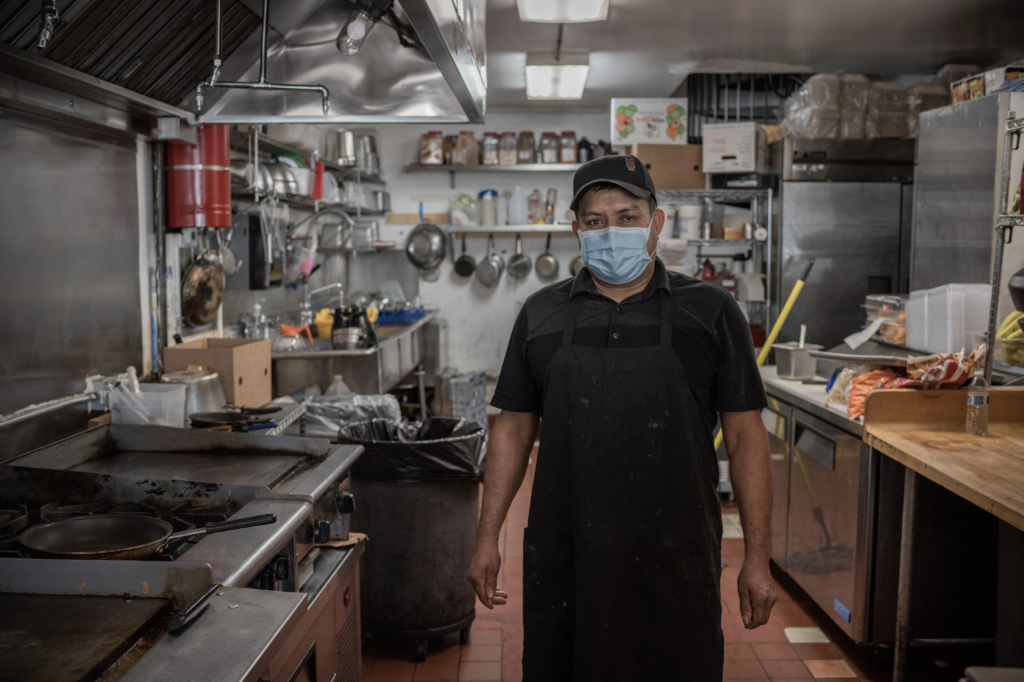
Martin is a chef at Homeskillet. Photo: Manuel Ortiz. Peninsula 360 Press.

About this, and more, I will write my column periodically. 

I will write about the flavors that can be found in the Peninsula and who creates those flavors, I will write about the food that we migrants miss and what we do to reproduce it here, far from our land. Restaurants in the area, are under notice, here we will taste and scrutinize their dishes. 

I am Anna Lee Mraz Bartra, a sociologist by training, a feminist by principle and a cook by love. 

Cooking is an act of love.

Latinas go for one last attempt to promote the 2020 census in Redwood City

Women from the Círculo Cultural and We Vote Redwood City take to the streets in a final attempt to promote the 2020 census

Listen to the note

Peninsula 360 Press editorial office

Redwood City. San Mateo County has the highest rate (72%) of self-reporting in the 2020 Census in California. According to journalist Pilar Marrero in an article for Ethnic Media Services, this was achieved "through their work with local organizations that know their communities very well. 

According to Megan Gosh, a census management analyst with the San Mateo County Office of Community Affairs, the agency has been working since January 2018 on census self-reporting efforts. 

"We had a lot of challenges: 13 of San Mateo's 20 cities have a combination of factors, having a census history that is classified as 'hard to count', as well as having unincorporated areas throughout the county," Gosh told Ethnic Media Services. 

But the campaigns haven't stopped. "There are areas in Redwood City that have very low participation. We want to increase the participation of our Latino community in these areas," said Connie Guerrero, director of We Vote Redwood City, an organization that has done intensive work in person and on social networks to promote census self-reporting in this city. 

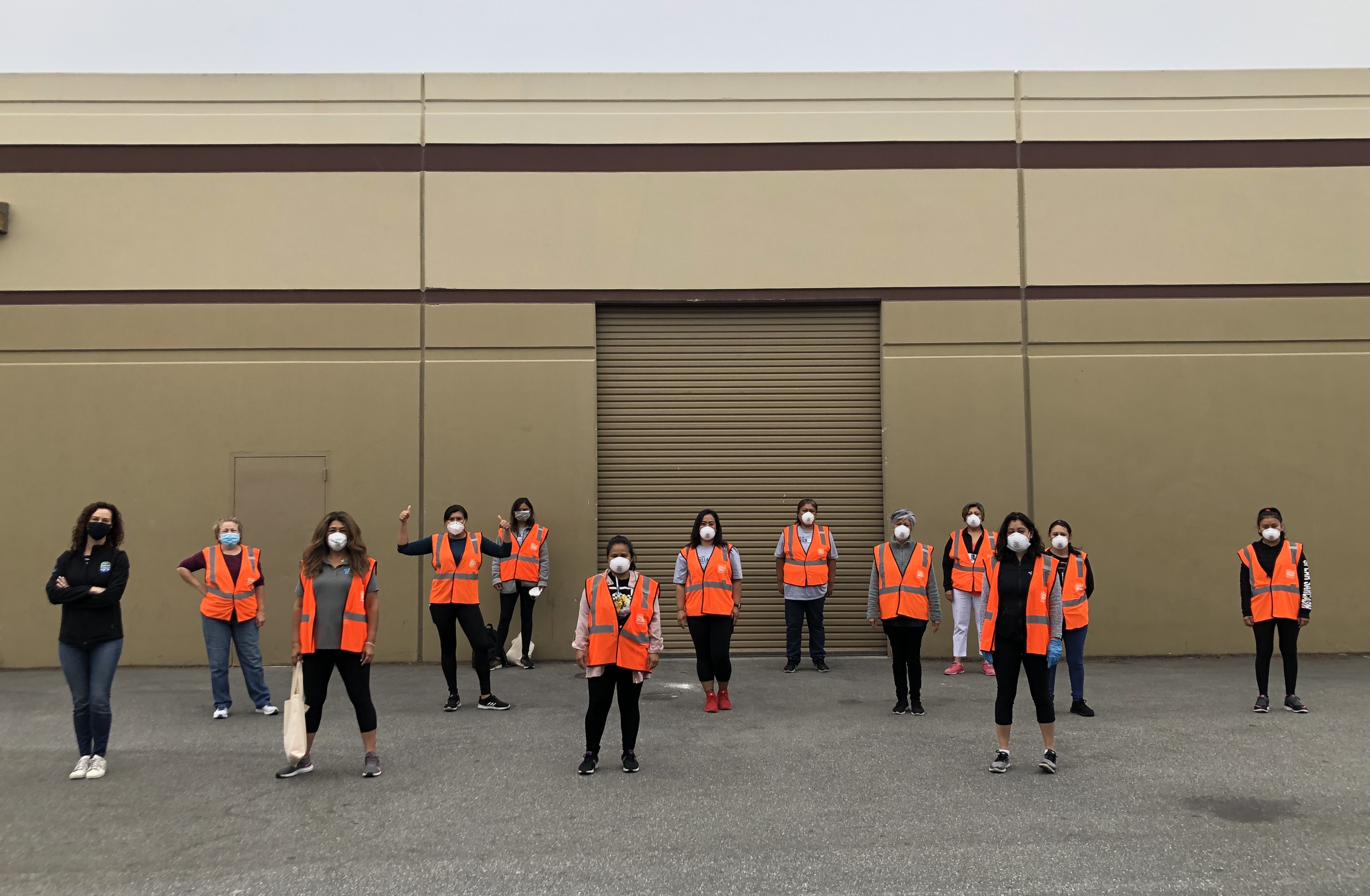
So on Sunday, September 12, a group of Latinas from Casa Circulo Cultural and We Vote Redwood City, accompanied by Redwood City Councilwoman Giselle Hale, took to the streets in a last-ditch attempt to "promote the census and, as Guerrero said, encourage people in these areas to get counted before September 30. 

"As you know, in the census we all count. No matter your legal status, being counted means that your voice and your community will be represented," Guerrero said. 

Proposals from Redwood City Council candidates

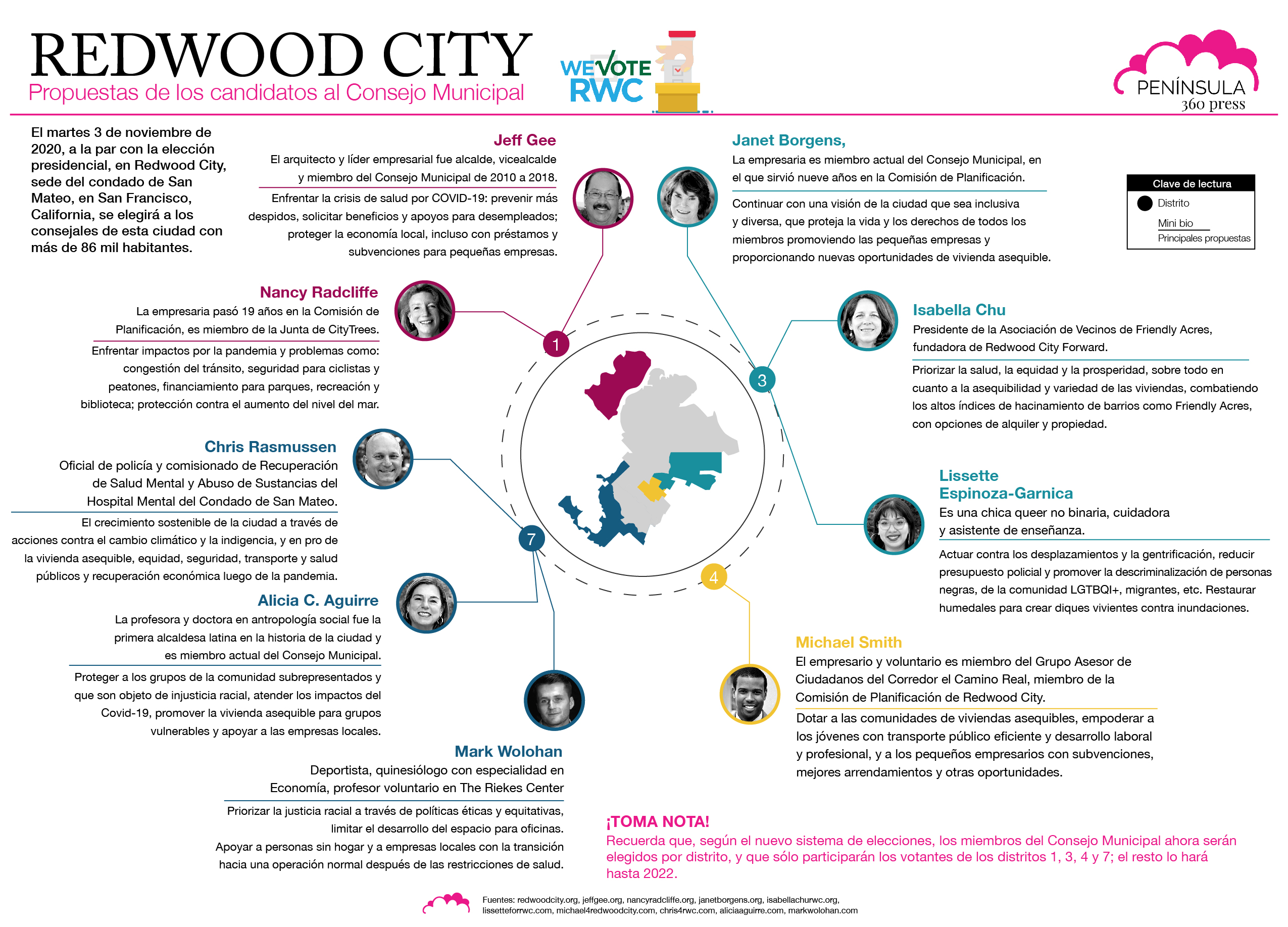
On Tuesday, November 3, 2020, at the same time as the presidential election, in Redwood City, California, the seat of San Mateo County, the councilmen of this city with more than 86,000 inhabitants will be elected.

Learn about their proposals through this infographic developed by the organization We Vote Redwood City and Peninsula 360 Press.

Click on the image to view it in full

Your voice. My voice. The voice of a Latino.

Connie Guerrero.

With nothing but my parents' dreams for a better life ahead of us, my brothers and I came, by their hand, to this country more than 40 years ago. The stars and stripes became my new home and the state of California embraced us.

My father, a gardener; my mother, cleaning rooms: nothing stopped them. They made every day count to let me know that We deserved a better lifeThe school taught me about math and differences. The color of my skin stood out in an American school. I stopped being Consuelo, that "Chelo" that came out of Sonora, Mexicoto become Connie.

At the time, I was not aware of the importance of the latino voice and vote.We will learn about how a decision can change the future of those around us who love us, how strong a voice can be, and even stronger if it is a community.

At 20 years old, I became an American citizen. It was my opportunity to finally make my voice heard and to stand up on behalf of all those who could not; on behalf of thousands of Latinos who, because they are not "legal", have had to hide their opinion.

With more than 15 years of activism,a time when I've been twice commissioned in RedwoodI have not stopped there so that the needs of a community that brings not only work, but great values and culture, are taken into account.

This 2020 has not been easy for anyone. From the economic issue to the climate issue to a pandemic that has not abated to anyone in the world. Racism and lack of empathy by the authority has also shocked the whole country. Nothing is indifferent to us. Everything affects us and hurts.

Learning that the needs of the Latino community didn't matter, that the Hispanic voice wasn't worth it "because they couldn't vote" hit me like a bucket of cold water. That was the reality. That's what we face every day.

In Redwood City there are over 80,000 peopleof them, around 42,000 are registered to votebut not even half of them exercise their right. The percentage of Latinos who can use their vote is very low and even more so than those who are registered to vote.

Thinking that their opinions or needs are not important - often having two jobs - little interest in local issues or the various proposals has discouraged them from votingwhich today is their right as citizens, in legal terms.

It's time to join forces, to move forward and believe that the future belongs to everyone and for everyoneI believe that our community, county, city, and country can be a true seedbed of opportunity for all. It's time for you voice, my voice, the voice of a Latino, be taken into account.

I call to raise awareness for the improvement of our environment in order to generate a change, which can only be achieved through voting, participating and inviting others who can also make use of their right.

Connie Guerrero is director of We Vote Redwood City

Facebook joins pollster recruitment campaign

Menlo Park, CA. Sunday, September 13th.

Facebook is launching a campaign to recruit poll workers in all 50 states this weekend to ensure that polling places during the November election can run smoothly.

All U.S. Facebook users 18 and older will receive a notification on Saturday to learn more about how to become a poll worker in their state.

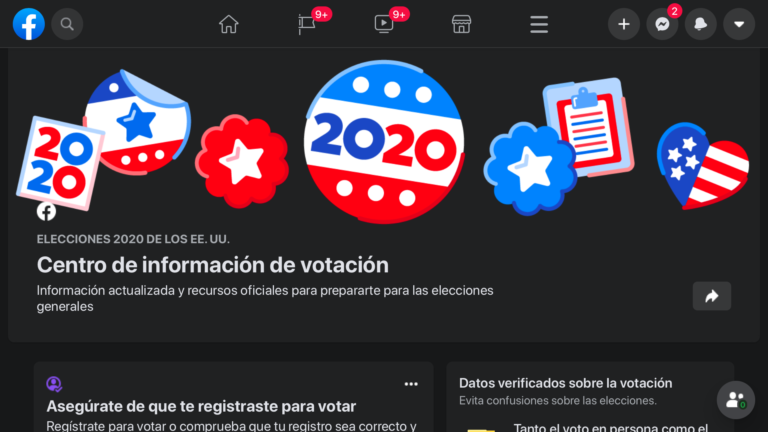
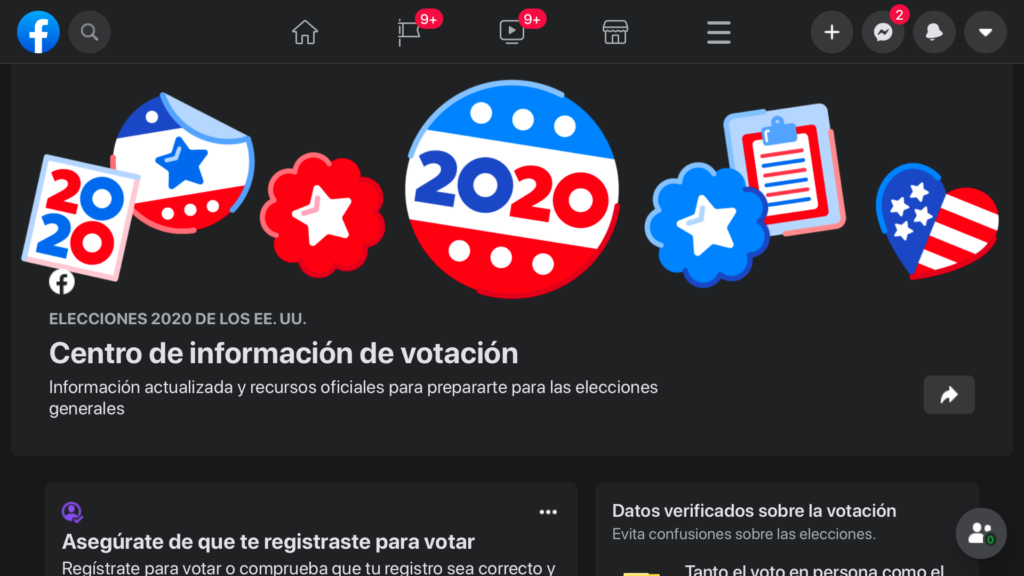
Preview of the Voting Information Center on facebook.com

The company will also offer free advertising credits to state election agencies for poll worker recruitment and a centralized voter information center on both Facebook and Instagram.

Facebook has pledged to help nearly 4 million people register to vote ahead of the election. general elections on November 3 and to take steps to curb misinformation about the elections and postal voting.

Facebook's voter information center is located at facebook.com/votinginfocenter.

[With BNC information]

Rancho de las Pulgas, heart of Redwood City

Veronica Escámez. Rober Diaz. Anna Lee Mraz. Peninsula 360 Press.

Thanks to its proximity to Woodside, Emerland Hills and AthertonThe city of Redwood City is one of the most technology-, education- and home-related places of employment.

Redwood City Memories. Facebook.

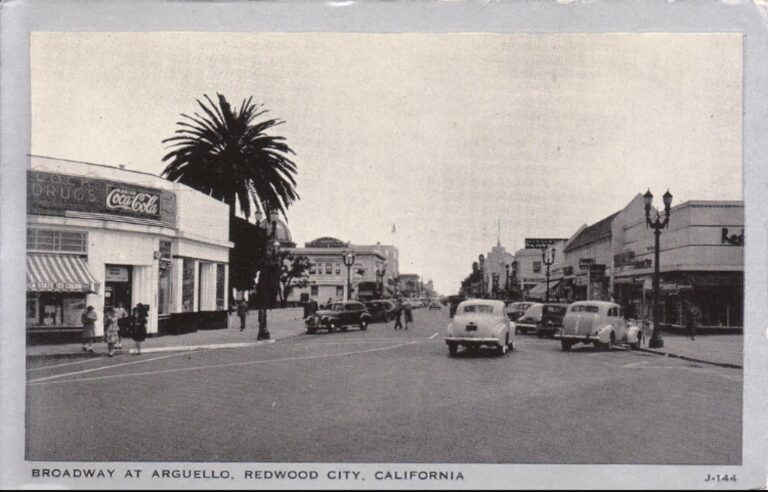
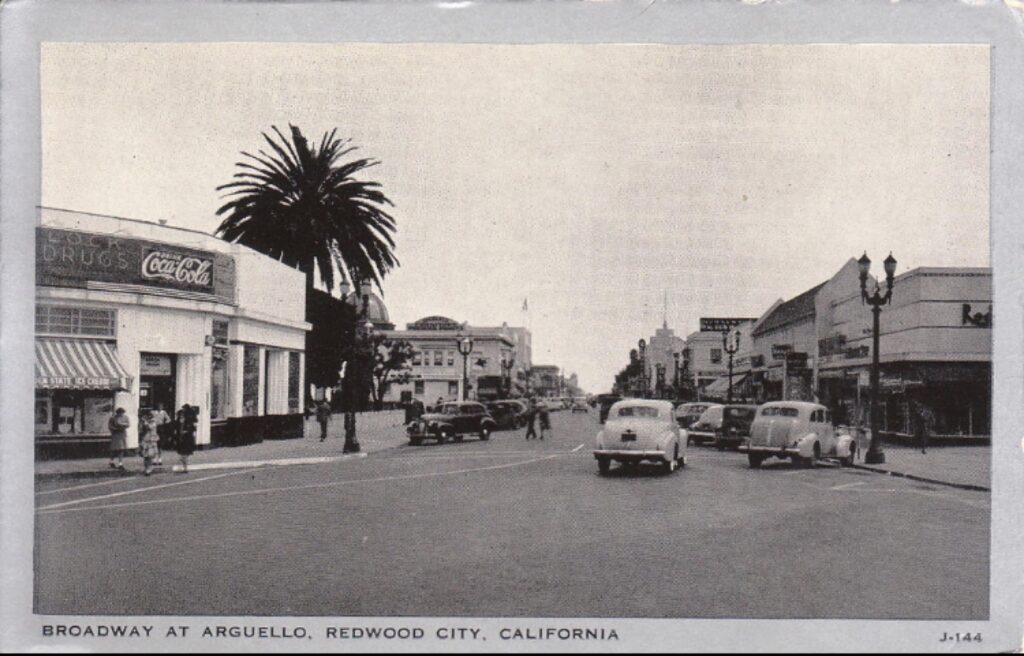
The history of the Flea Ranch The Spanish conquistadors and missionaries occupied the territories of the region in the midst of a great transformation. In 1781, the Spanish government decided to settle the area of Northern California through the Rivera and Moncada Expedition. On this expedition, there was the young soldier, José Darío Argüello

Argüello had joined the regiment as a private, but because of his leadership skills, he soon rose to become a sergeant. The tradition of the Spanish government was to reward its best soldiers with land grants; it was thus Governor Diego Boric awarded two land grants in 1795 to José Darío Argüello.

The following year, José Darío was assigned to the Presidio in San Francisco as commander and he stayed there for 10 years, when he was appointed Acting Governor of California in 1814

Luis Antonio Argüello, son of the commander José Darío Argüello, was born in the San Francisco Presidium. He grew up surrounded by a military environment becoming a cadet at 15. In 1822, Louis married Maria Soledad Ortega. The wedding was a big event and the party at the ranch lasted several days. Luis was appointed as the first governor of California under the now new Mexican government in 1822. When he died at the age of 46 in 1830, Maria Soledadhis widow, inherited the Flea Ranch. The original concession covered what is the current San Mateo County, California. This concession was limited by San Mateo Creek to the north and San Francisco Creek to the south. It consisted of more than 35,000 square meters, or 142.6 hectares.

The agitation of the gold rush of 1849 in California led to stability, and Spanish-Mexican citizens had to prove to the land commission that they were the legal owners in order to retain their property rights. By the time Maria Soledad received her inheritance, the United States had just won from the Mexicans the conflict known as The Cake Wars and, after the Treaties of Guadalupe HidalgoIn the end, the Argüelles family was left with just under half of the land grants. The U.S.-confined acres became part of the state of California.

It was for the year 1867 that Redwood City was incorporated and was instituted as the first city in San Mateo County being its headquarters; it has a deep port in the south of San Francisco Bay. In 2010, it had a population of approximately 76,800 people, of which 38.9 % were Hispanic. Thanks to its geographical location - exactly halfway between San Francisco and San Jose - Redwood City is one of the places with more employees related to technology, education and domestic work in the United States.

As the philosopher said Yuval Noah HarariIn this sense, the capital that the territories currently have is not only worth for the resources they provide, but also for the knowledge and technology that is generated in the place.

Redwood City got its name from the huge redwoodsThe giant trees that are found in the vicinity of the city. Redwood City is a place festive whose origin is attributed to it, to a greater extent, to the large number of Mexicans who live in the cityincluding the Day of the Dead, sponsored by Casa Circulo Cultural, which attracts 10,000 attendees each year.

The 1990 Nobel Laureate in Literature, Octavio Paz, offered us an explanation for this propensity of nations to party:

"The lonely Mexican loves parties and public gatherings. Everything is an occasion to gather. Any pretext is good to interrupt the march of time and celebrate with festivities and ceremonies men and events. We are a ritualistic people. And this tendency benefits our imagination as much as our sensibility, which is always in tune and awake. The art of celebration, debased almost everywhere, remains intact among us.

Octavio Paz, "The Labyrinth of Solitude", 1950.

The city celebrates U.S. Independence Day parades on July 4, Christmas, the local Mont Carmel festival, and street parties on May 5 and September 15 at the Middlefield Neighborhoods, Fair OakThe Hispanic heart of the city. 

How San Mateo became California's #1 success story

By Pilar Marrero /Ethnic Media Services

San Mateo County has achieved the highest census response rate in California by working with local organizations that know their communities well and creating messages specifically for those communities.

That massive work and effort was carried out by trusted messengers and "on the ground" messengers throughout the county, and was funded by more than $$1.3 million in state and county money, officials said June 30 this year during a teleconference hosted by Ethnic Media Services.

San Mateo County has achieved a 72.8% autoresponder in the 2020 Census, higher than the state average: 62.9%, and the nation's: 61.8%.

That means that nearly three out of four county residents have already filled out the population questionnaire, well before the door-to-door visits by census enumerators, which are scheduled to begin in mid-July in some parts of the U.S. and in August for the rest of the country.

San Mateo County is located in the Bay Area of the San Francisco Peninsula, between the cities of San Francisco and Palo Alto, and is made up of very diverse communities, and the high number of self-sponsors varies widely. Some cities in the county, such as Pescadero and East Palo Alto, are far behind in the count, according to local groups.

Megan Gosh, census management analyst for the San Mateo County Office of Community Affairs, said the county began working on the project to boost census responses in January 2018.

"We had a lot of challenges: 13 of San Mateo's 20 cities have a combination of factors, having a census history listed as "hard to count," plus having unincorporated areas throughout the county," he said.

Hard-to-count groups include renters, people who reside there but are non-citizens and have limited English proficiency, and children under 5, he added. California, in general, is a hard state to count.

The lack of affordable housing in the county results in many addresses not being known to the Census Bureau because they are tied to "non-traditional" housing units, such as converted garages and recreational vehicles. In other cases, people living in rural areas do not receive letters or questionnaires because the Census Bureau does not mail them to P.O. Box addresses, on which most rural residents depend.

"We've worked with the city's urban planners and local organizations to go around the areas with those non-traditional housing units to add their addresses to the master census list," Gosh said.

That county project was able to add 2,000 addresses to the census master records. Using a conservative number of two people per household, those additions would have resulted in $$4 million per year for the county because population counts are tied to the distribution of federal and state resources. The results are also used to create voting districts that are intended to ensure political representation for all communities.

Counts that result in fewer than the actual number tend to reduce that representation.

Gosh and other county and community leaders described the more than two-year effort to get up close and personal with those communities and the things that motivate them, sometimes having to shift focus to tailor messages and convince people to participate in the census.

"For example, we learned that tenants living in Daly City did not want to participate in the census because of a lack of trust in sharing their information," explained Melissa Vergara, a census specialist for San Mateo County.

"So we created a printed message to hang on the doors of homes that specifically touched on the issue of confidentiality laws that apply to the census."

Other areas are receiving "hyper-targeted" messaging through social media campaigns and postcode-based online ads, as well as video and bus stop billboards. It also helped to have promotion through religious congregations and in different languages, depending on the local ethnic composition.

Creativity and flexibility are key parts of the strategies local organizations have used. Rita Mancera, executive director of Puente de la Costa Sur in Pescadero, said her community was badly undercounted during the 2010 census, and said that "no single platform works" to reach everyone.

"The 2010 census counted 2,019 residents in our community, but we knew we had served at least 1,600 people, so we estimated we had between 5,000 and 6,000 residents, most of whom had not been counted," Mancera said. She estimates that approximately only 33% of the community was counted in 2010. So far this year, Pescadero's response rate is 46.1%. "And it was very difficult to get to that," she adds.

Many immigrant residents are simply distrustful because of their experience in their home countries, Mancera says. But the organization has used its relationship with those communities and families to get them to participate in the census.

"We give help to about 200 households every Thursday, encouraging them to use the phones to respond to the census," he explained.

"We hired a person to call about 250 families, to whom we had sent school supplies last year, to let them know that we could help them respond to the census over the phone. There's also a lot of informal communication.

Another example of how a motivated community, working with a trusted local organization, can exceed expectations, as was also the case in Pacifica, a city where the autoresponder rate has been higher than that of San Carlos, a neighboring and more prosperous city.

"We've taken advantage of the trust they have in us," said Anita Rees, executive director of Pacifica Resource Center.

"Our organization has been serving the area for 45 years. This is a passionate community, sometimes divided on certain issues, but the census has become a common theme. For us, the message that the census is the way they're going to make themselves heard has worked, plus, the community is competitive: they wanted to beat San Carlos."

Outreach to the Asian community has been very targeted, said Nina Li, San Mateo County's outreach coordinator. More than 30% of the county's population is Asian. Chinese, Tagalog and Hindi are the most widely spoken languages other than Spanish.

Immigration status has been key to reaching out to diverse Asian populations, in addition to language, said Li, who like many people in her community is a legal permanent resident, but not a citizen, and is experiencing her first decennial census.

"In our community, for many people this is a new concept, and they have the misconception that this is similar to an election where you have to be a citizen to participate, but that's not the case," Li said.

Li says that in their promotional activities they have used We Chat, a popular social networking platform in Asia, and targeted messages to permanent residents and even those on temporary visas.

"I'm not a citizen, but I go to parks and libraries, I use public transportation and my daughter is going to public schools, and all of these services will be impacted by the 2020 census for the next 10 years," she said. "We're making sure people know that."

Lisa Tealer, executive director of the Bay Area Community Health Advisory Council, said African Americans, Latinos and others in East Palo Alto are responding to the idea of reclaiming the power of "being counted," a phrase that historically has had negative connotations because, in the past, the census has been used to discriminate against some communities.

"Now we claim it as our power, and we want to be counted because we helped build this country," Tealer said.

Similarly, residents of the Pacific Islander community respond to the idea that the census is a way to secure resources for the next generation, according to Talavoy Aumavae, leader of the Committee for a Count.

Completed by the Pacific Islanders of San Mateo County.

"We highlight the fact that our ancestors had migrated here for better opportunities for their families, and it is imperative that we see the relationship between the census response and our futures," Aumavae said.

Opinion Test

Lorem ipsum dolor sit amet, consectetur adipiscing elit, sed do eiusmod tempor incididunt ut labore et dolore magna aliqua. Ut enim ad minim veniam, quis nostrud exercitation ullamco laboris nisi ut aliquip ex ea commodo consequat. Duis aute irure dolor in reprehenderit in voluptate velit esse cillum dolore eu fugiat nulla pariatur. Excepteur sint occaecat cupidatatat non proident, sunt in culpa qui officia deserunt mollit anim id est laborum.

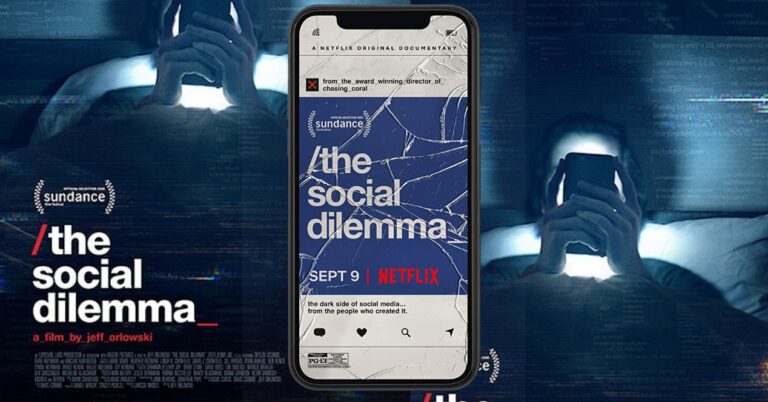
The Social Dilemma, by Netflix, to rethink social networks

By Crisitan Carlos / Peninsula 360 Press

If you were a fan, for example, of the episode of the third season of the series Black MirrorNosedive" -or "Caída en Picada" in Latin American Spanish-, you might be interested to know that the streaming platform premiered a documentary directed by Jeff Orlowsky: The Social Dilemma -"The Social Networking Dilemma" in Spanish-. 

Here you will find the preview of the documentary:

As you can see in the preview, The Social DilemmaNetflix's "The Netflix social networking site," reflects serious consequences on the actual use of social networks while instilling panic in regular users. Many people have even rethought - because it would not be the first time we have had such an idea or even done it - to close their profiles containing identity data stored in the cloud.

This is how the documentary was announced The Social Dilemma through his official Twitter account.

The documentary is now available in the catalogue on the streaming video platform -or streaming- from this Wednesday, September 9th after its run at Sundance.

The documentary tries to capture through fantasy and reality, how social networks can manipulate the perception of oneself in search of perfection and that contrasts with a sad reality, leading to serious mental health problems. Or even influencing the great social conflicts we live in today.

So as not to spoil your experience before watching the documentary, keep in mind that fact trumps fiction, so if you like conspiracy theories, maybe this feature film is a window into the truth that you didn't really want to know in the first place. Now do you really want to see The Social Dilemma on Netflix? Click here.