Briana Evans has become Redwood City's first equity and inclusion officer, a position in which she will support the City Council's efforts to make equity a key guiding principle for the City's strategic plan.
As a member of the City Manager's Office, Evans will work with the City Council and staff to develop an Equity Work Plan that reaches across all city services.
"Redwood City has a rich history of community engagement and welcoming everyone into our community. With the City Council's support for this new position, we can increase our focus on diversity, equity and inclusion in both policymaking and City operations," said Redwood City Manager Melissa Stevenson Diaz.
She added that Briana will be a strong leader, accelerate efforts already underway and develop new initiatives based on best practices.
Evans holds a master's degree in social and cultural anthropology and a bachelor's degree in medical anthropology, both from Stanford University.
She also has a strong background in research, policy, and leadership, and brings an innovative and forward-thinking approach to complex issues. Most recently, Evans worked as an equity design strategist with Reflex Design Collaborative, a consulting firm that uses collaboration to design solutions that improve social equity.
Previously, she supported the San Mateo County Health Department's Office of Diversity and Equity, where she designed organizational change strategies and trained community leaders to create a more culturally humble and inclusive behavioral health care system.
"My passion is to make sure that everyone has a voice and can bring their best to the world. I believe in the wisdom and strength of communities, including those who have been marginalized for generations," Evans said.
In a statement, the new equity officer said she is eager and excited to support and challenge Redwood City "to listen and act on systems change, inclusion and community engagement that is built with communities, not for them.
After San Mateo County went "Red" following months of closures due to the COVID-19 pandemic, hundreds of establishments are beginning to open their doors, but the next problem to solve in Redwood City will be finding parking.
Remember how hard it was to find a parking spot when you went out to a movie, restaurant or bookstore in the Bay Area on a Friday or Saturday? Well, that could soon be over thanks to a measure being taken to make that a thing of the past.
After a pandemic year, where business closures were the bread and butter, Redwood City's 245 downtown stores, restaurants, theaters and businesses are eagerly awaiting the return of customers.
According to some media, in recent months, the demand for parking was reduced by 90 percent, however, currently, it is at 50 percent, which shows that, every day, people are slowly returning to enjoy spaces in the city.
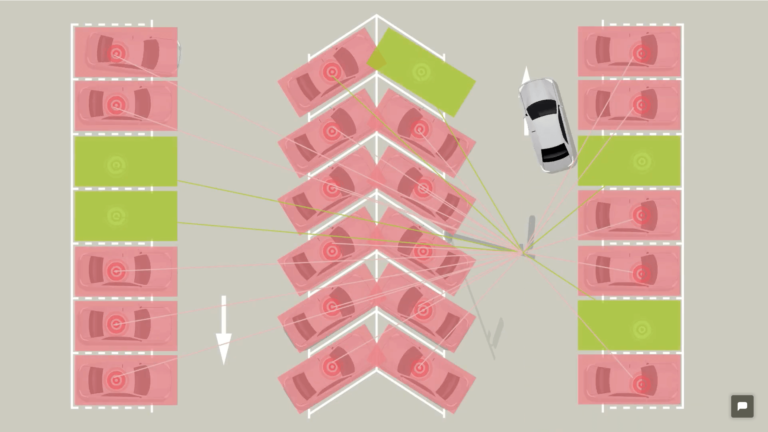
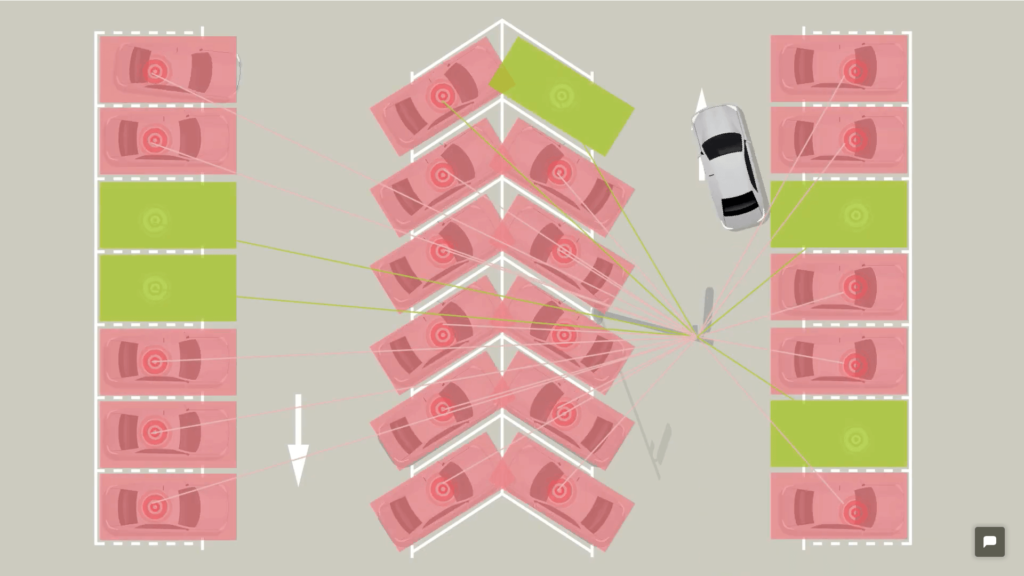
Its name is Cleverciti and it came from Germany. Its installation is already underway. It is a network of sensors mounted on light poles that can identify empty spaces; not only the 400 on the street, but also in seven lots and 11 garages, reported ABC7.
The 360-degree LED signs, mounted 20 feet high, show step-by-step directions to where to find empty spaces and how many are available.
It should be noted that Redwood City is the first city in the U.S. to have this system, and the system is expected to begin operating this summer.
The parking alert system will make it easy to find a spot in Redwood City, Cleverciti promises to reduce search times by up to 45,m not bad for those who are looking to spend more time on other activities than on running around trying to find an empty space.
After the city of San Francisco recently joined forces to tighten security, especially for members of the Asian-American community, a new video was released of an attack on an elderly Asian-American man at a laundromat in Chinatown.
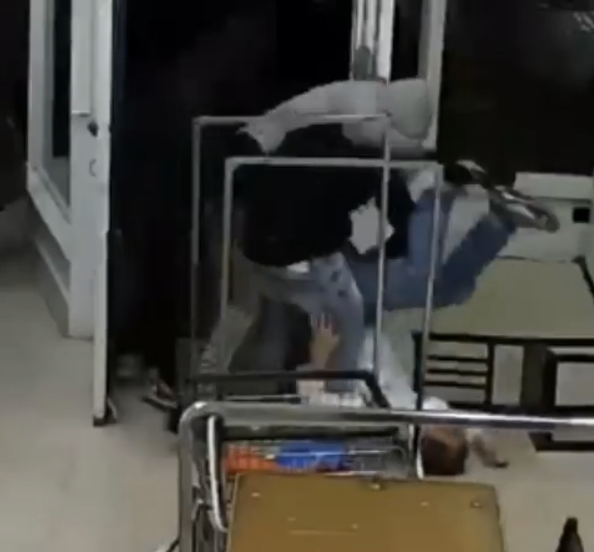
According to the media ABC7The video, which belongs to the closed circuit of the same establishment, shows the terrible attack on a 67-year-old customer, who is raped by three people in a laundromat around 10 p.m. on February 23.
In the video you can see how the older man was ambushed by three men and dragged and then robbed of several dollars, all in a matter of about 45 seconds.
The violence in the area continues unabated despite the efforts of the San Francisco Police Department (SFPD) and residents themselves, who have formed alliances to watch out for and protect seniors who are susceptible to these types of attacks.
It is worth noting that last February 18, SFPD community liaison members handed out flyers to raise awareness about the value of the Asian American community to prevent further attacks against them. Since then, the work has not stopped.
Robert Rueca, SFPD public information officer, spoke to ABC7 about the newly appointed central station captain's effort to include a greater patrol effort and "ability to respond to the needs of the community."
The official stressed that despite law enforcement efforts, including Chinese-language hotlines, residents must remain vigilant against any attacks.
It should be noted that the San Francisco Police Officers Association (SFPOA) is offering a $2,500 reward for anyone who provides information leading to an arrest.
"These random acts of violence against members of our Asian community are no accident and must end. The SFPOA stands with our Asian community and all San Franciscans in wanting these perpetrators caught and held accountable," said Tony Montoya of the SFPOA.
Finally, the San Francisco Police Department called on the entire community to remain vigilant and stay safe, and encouraged any witnesses to these violent acts to call 415-558-5588, where they can receive support and translation in Cantonese and Mandarin.
They release video of new attack on Asian-American senior in San Francisco at a laundromat in Chinatown via Instagram.
One person was wounded in a shooting in Fremont Wednesday morning, an investigation that led authorities to cordon off a home in another part of the city, according to police department information.
The shooting was reported at 10:50 a.m. in the 5700 block of Lemke Place. The victim was transported to the hospital with life-threatening injuries.
Additionally, the police department said several people were detained after the shooting and that, over the course of Wednesday afternoon, a home in the 43000 block of Ellsworth Street was also cordoned off as part of the investigation.
The residence and surrounding area were secured, and no lockdowns have been issued, police said.
Just hours ago, the Fremont Police Department stated in a tweet that the victim - in custody by authorities - is out of danger.
In addition, a 15-year-old boy was arrested for the shooting and charged with weapons possession and attempted murder.
A 15-year-old juvenile has been arrested for the shooting and was booked for attempt murder and firearms possession. Detectives are continuing to work on identifying and arresting additional suspects.
- Fremont Police Department (@FremontPD) March 4, 2021
The East Palo Alto Council will hold a special study session Thursday with San Mateo County leaders and health officials to discuss COVID-19 vaccine deployment, testing and contact tracing.
Speakers include Justin Mates, deputy county director of San Mateo County; Luisa Buada, CEO of Ravenswood Family Health Center; and Dr. Anand Chabra, chief of the San Mateo County COVID-19 mass vaccination section.
East Palo Alto will be considering an immunization plan for COVID-19, the session is scheduled at 6 p.m. via Zoom conference call. The session will include presentations from speakers and an opportunity for members of the public and council members to ask questions.
Officials in the the San Mateo County Board of Supervisors have asked the federal government and the state of California to prioritize residents of East Palo Alto and other low-income communities to receive the COVID-19 vaccine, as they have been among the areas most affected by the SARS-CoV-2 virus.
Because many low-wage, essential workers live in those areas, local, state and federal governments need to focus on improving the quality of the people who put their lives on the line every day to move everything forward, said Democratic state Sen. Josh Becker.
"This community has been on the front lines and has provided human capital to allow those of us who have the privilege of working from home to continue to do so," Becker said at a press conference outside Cesar Chavez Ravenswood High School in East Palo Alto.
He added that these residents, "have been with us during our darkest hours and should be treated as the priority they are."
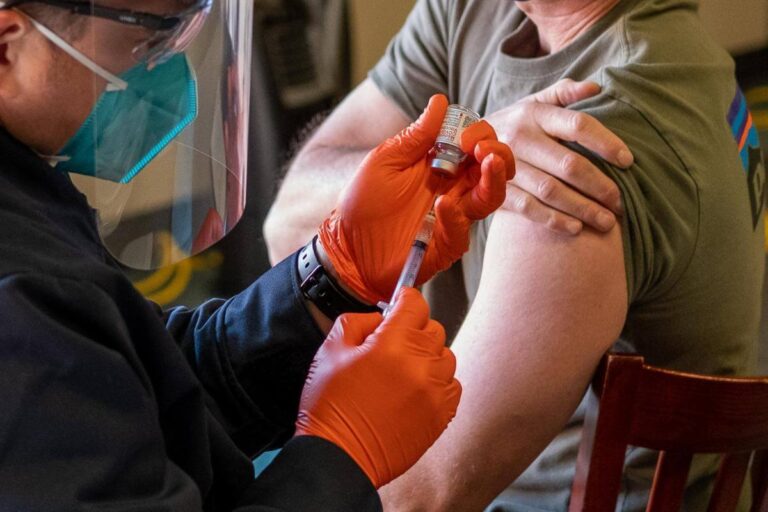
It's worth noting that East Palo Alto has one of the highest rates of COVID-19 positive cases in the county, but also the lowest proportion of residents who have received the vaccine, with less than 12 percent of people living in the predominantly Latino city having received at least one dose of the vaccine.
And while the city is close to million-dollar corporations, structural inequalities have affected the gap in various sectors to become wider and wider compared to other parts of the county, Councilman Antonio Lopez said at the time.
"There are still two sides in the Bay Area: one with instant and immediate access to basic resources, and the other struggling to figure out how to keep their family safe," he said.
And, low-income residents often face additional challenges to getting vaccinated, as, among other issues, lack of Internet connectivity limits them from signing up for appointments or simply lack of transportation makes it difficult to access a vaccination site.
In addition, undocumented immigrants living in East Palo Alto, where 40 percent of the population is foreign-born, are reluctant to get immunized because of the belief that they could get in trouble with immigration authorities and be deported.
In that regard, San Mateo County officials are working with a local community clinic, Ravenswood Family Health Center and other trusted organizations to inform East Palo Alto residents about the vaccine and immunize those who are eligible, said Deputy County Manager Justin Mates.
"San Mateo County recognizes that persistent inequities affecting communities with the highest exposure to COVID-19 also contribute to barriers to reaching all who are eligible for vaccination," Mates said in a statement.
Santa Clara County has opened large vaccination sites in affected communities and has gone door-to-door to inform residents that the vaccine is safe, free and available regardless of immigration status.
However, San Mateo County has not yet opened a large vaccination site in East Palo Alto, nor has it set up mobile clinics in the area, although local officials are considering the strategy, said David Canepa, chairman of the San Mateo County Board of Supervisors.
The biggest problem, he said, has been that the state is not providing a sufficient or steady stream of vaccine doses to counties, and local officials struggle to plan ahead to get the ever-changing supply into people's arms.
In that regard, he said that with the recent approval by the U.S. Food and Drug Administration (FDA), which only requires one dose, things may change, allowing such immunizations to be targeted to front-line workers like those in East Palo Alto.
The Palo Alto City Council has given nonprofits that rent space at the Cubberley Community Center a break by granting them three months of rent relief to help them restart operations that had been slowed by the COVID-19 pandemic.
During a discussion last Monday, the city council also directed its Policy and Services Committee to explore further measures that could support businesses that provide services such as child care or music lessons.
Notably, Palo Alto anticipates a budget deficit of about $7 million in fiscal year 2022, which begins July 1; meanwhile, it already suffers from $4.8 million in debt.
The gap between the two fiscal years is intended to be reduced, in large part, by drawing resources from a special reserve the city had established last year to deal with unforeseen impacts of the pandemic, as well as by eliminating the travel budget for city staff and reducing administration expenses.
During the same session, the council ratified eliminating dozens of positions at City Hall due to falling revenues, so 83 full-time and 107 part-time positions across the organization will not be returning anytime soon.
However, despite the shortfall, council members agreed to waive about $203,000 in rent payments for the 19 tenants who qualify for relief under the approved rules.
The exemption will apply only to "small organizations," those that had revenues of less than $2.5 million in 2019, and those that were forced to stop operations due to the pandemic.
"We've asked other landlords to be flexible; I think we have a responsibility to do it ourselves," Councillor Alison Cormack said at the time.
Faced with divided opinions over the eligibility of businesses to qualify for the aid, Councilman Greg Lin Tanaka suggested the city delay approving the aid program and spend more time determining who should qualify.
During the meeting he pointed out that the revenue cap is only one criterion to be considered, as the city should also consider is the scope of these organizations, the services and needs they provide and are used by residents.
It should be noted that any additional action taken by the city council would add to the city's budget deficit, so approving three months of rent forgiveness for the 68 tenants would cost the city about $875,000, according to staff.
While limiting aid to the 58 tenants who have had to stop operations during the pandemic would add 751,000 to the revenue shortfall.
The measures to get support for the nonprofits include deferring infrastructure projects for several city parks and repairing some streets. The request came exactly one month after the council approved a construction contract for a public safety building expected to cost $118 million.
After a nearly 12-year battle where the Cargill Salt Company sought to develop and expand its property in the San Francisco Bay Area near the port of Redwood City, the U.S. Environmental Protection Agency withdrew Friday an appeal made during the previous federal administration, concluding that the area is subject to the federal Clean Water Act.
The potential expansion meant billions of dollars in business for Cargill, a private Minnesota-based company that evaporates water on the 1,365-acre property in "crystallizer beds" to produce salt for industrial uses.
However, the land, being subject to the 1972 Clean Water Act, sharply limits what can be built in the area, a ruling that environmentalists widely applauded, saying for years that the land, which is at sea level and was once part of San Francisco Bay before it was leveed in 1902, should be restored as tidal wetlands for fish, wildlife and recreation.
They also argued that any attempt to develop the land in front of the bay is impractical due to sea level rise.
"We're thrilled that President Joe Biden's administration is doing what Trump didn't, which is upholding the law and protecting clean water, wetlands and the Bay," said David Lewis, executive director of Save the Bay, an Oakland-based environmental group.
At the same time, he detailed that there was always broad and deep opposition in the Bay Area to building on the property, yet Cargill had found a friend in the Trump administration.
According to the salina's attorneys, the property is dry land separate from the bay and is not subject to the Clean Water Act, which requires a federal permit to fill "waters of the United States."
In light of this, Cargill will not give up on its attempt to make the extension, as it says it plans to move forward with an appeal in the U.S. Ninth Circuit Court of Appeals.
"Our focus has always been to protect environmental resources and work with our neighbors in the Bay Area to consider future uses of the site," David Smith, an attorney for Cargill and DMB Pacific Ventures, an Arizona company that has sought to develop the property, said at the time.
During 2009, Cargill and DMB proposed to build 12,000 homes on the industrial salt production land along Seaport Boulevard north of the Dumbarton Bridge, a project that would have become the largest development on the San Francisco Bay shores since Foster City was built in the 1960s.
But, again, the project was withdrawn in 2012 amid opposition from community groups and environmentalists.
Cargill does not remove the finger from the line and maintains that it seeks to advance in Otero project, however, has not offered details.
We should remember that, in 2016, during the Barack Obama administration, the Army Corps of Engineers ruled that Cargill's property was not subject to the Clean Water Act, yet the U.S. Environmental Protection Agency (EPA) in San Francisco came to the opposite conclusion. And under federal law, the EPA can override the Army Corps in special circumstances.
The issue fell by the wayside, and along came the Trump administration, which took it upon itself to give the saltworks an open letter, signing a letter concluding that the property "is not subject" to the Clean Water Act's development restrictions. Environmentalists did not sit idly by and filed a lawsuit to challenge the decision.
With the Biden administration, things changed again, as it appears that the environment will be a priority, as U.S. District Court Judge William Alsup, in relief of environmentalists' arguments, ruled that the area is still connected to the bay by tide gates and intake pipes, and most importantly, it's wet.
EPA halts Cargill salt plant, prevents expansion of Redwood City facility, EPA withdraws appeal from past administration.
It should be noted that the matter is not over, and there will be more legal problems, as the environmental groups sued the EPA, not Cargill, and the appeals court will have to decide whether the salt plant still has standing in the case to continue with the appeal of the lower court's decision.
On March 2, 2020, children from all over San Mateo County came together to enjoy "Read Across America Day."
In the presidential race, Vice President Joe Biden had just won his first primary.
Local news headlines said a sold-out crowd of 18,064 watched the injury-plagued Golden State Warriors lose by 14 at home last night.
Students at high schools in Burlingame, Redwood City and Half Moon Bay, meanwhile, held weekend sports championships.
And everyone enjoyed a pleasant 70 degrees from Daly City to Half Moon Bay to San Mateo. All in all, a good late winter day.
San Mateo takes stock one year after COVID-19 pandemic. The Health Department reported the first known local case of COVID-19.
"That was the turning point where it changed life as we knew it. At the time, we didn't know how profound those changes would be," said county administrator Mike Callagy, who also serves as countywide emergency services chief.
"This is a moment we will all remember because since then we have all been challenged like never before in most of our lives," he added.
The county laid the groundwork for activation of the Emergency Operations Center -EOCThe county health department detected the threat of COVID-19 and activated its own Department Operations Center when SARS-CoV-2 arrived in the U.S. in January. The County Health Department detected the threat of COVID-19 and activated its own Department Operations Center when SARS-CoV-2 arrived in the U.S. in January.
At the time, the county indicated through a statement that the first few days of the EOC activation there would be physical distancing, but no need for masks. Still.
Also, providing food to those in need of isolation was and remains a high priority.
It was recalled that "The Mask Mobile" has distributed more than 26,920 masks across the county since it was first launched last year.
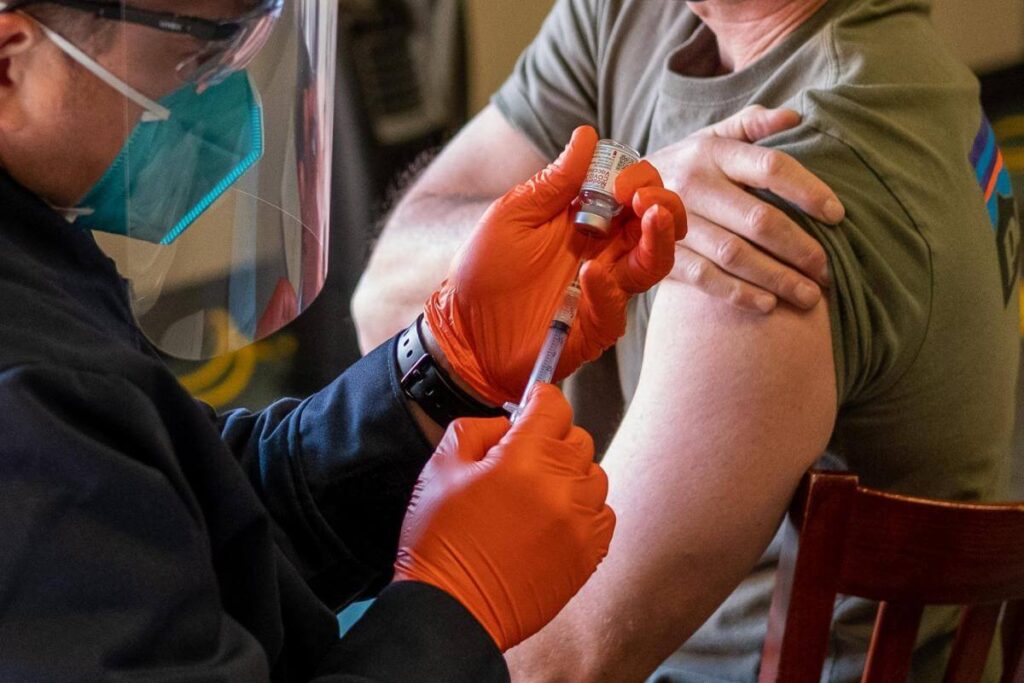
It was also noted that San Mateo County Health is actively working through the various phases of distribution as quickly as possible to direct the limited supply of vaccine to the identified priority groups.
In that vein, San Mateo County has launched a "Come Back" campaign to unite residents and remind them of "all the steps we need to take to stay safe."
Then, the county increased the EOC's planning functions and staffing to prepare for activation on March 2, 2020, when its operations would run 24 hours a day, 7 days a week.
"The Emergency Operations Center is the heart and soul of our community's response to COVID-19," said David J. Canepa, chairman of the San Mateo County Board of Supervisors and chairman of the county's Emergency Services Council.
Since the pandemic began, the EOC has led the response through timely and accurate communications to the public and by organizing, coordinating and delivering vital services to the community. This includes $97 million in direct assistance to individuals, families, small businesses and community-serving organizations, the county said.
As compiled by the San Mateo Recovery Initiative, the county has provided:
16.05 million to 4,269 individuals and families
11 million to 657 small businesses
38.56 billion to nonprofits that serve the community
4 million to Second Harvest Food Bank to help provide food for residents
1,208 people served in supportive housing for isolation and quarantine (Alternative Housing Sites), along with tiered medical support (Alternative Care Site).
Approximately 1.5 million meals for vulnerable residents through Great Plates Delivered program
The COVID-19 Pandemic in San Mateo County by the Numbers:
Total number of people vaccinated: 157 thousand 337
People who completed the vaccine series with two doses: 61,621
Total number of vaccine doses in the arm: 218,958
Total number of COVID-19 cases: 38,865
Total deaths related to COVID-19: 521
As of this Monday, March 1, the EOC is integrated into the County's Regional Operations Center -ROC, a $64.5 million, two-story building in downtown Redwood City, which opened in late 2019.
The ROC also includes the Public Utilities Safety Communications 9-1-1 system and the daily offices of the San Mateo County Area Office of Emergency Services.
In addition, the Strong San Mateo County Fund, a public-private initiative that raises funds to help individuals, small businesses and non-profit groups that are experiencing financial hardship due to the pandemic, was created.
The following information is the result of research conducted by a team of journalists, members of the Diploma in Data Journalism and Investigative Techniques -focused on organized crime-, which was given by the Carlos Septién García School of Journalism in Mexico City.
Child exploitation is a form of organized crime that profits from the recruitment and sexual abuse of children and adolescents on various digital platforms, especially social networks.
Often, the person behind a profile is not a person, but an "impressive child pornography" network. It all starts by asking for a photograph of the child to blackmail the family.
"If you don't give me a certain amount of money, I'll show the photo or do something to your child," said María Isabel Christensen, head of Research and Prevention at the NGO Mamá en Línea, an organization based in Argentina, dedicated to prevention and training to combat drug trafficking. grooming and online bullying.
The COVID-19 pandemic exacerbated the systemic economic and social inequalities that are among the underlying causes of the crime of trafficking in persons.
The risk of being a victim of these crimes increases just as much for teens who begin to practice sexting -The practice of sending messages, photos or videos with erotic and personal sexual content via mobile phone - a practice that continues to grow during the quarantine period.
The sale of child abuse and exploitation material makes a lot of money, so much so that it is one of the three most lucrative activities for criminal organizations after drugs and arms trafficking.
How do pornography groups operate?
These organizations and groups also create the didactics of getting what each consumer wants, according to their tastes: the selection of a victim by age, characteristic, skin tone, etc., gives rise to other crimes such as human trafficking and kidnapping.
One of the main strategies of perpetrators and criminal organizations is to simulate an identity different from their own. Usually, they pretend to have the same age, tastes and preferences as the victims they have selected. Even an innocent photo next to a door, park or any location gives them enough material to study in detail their victim, who naively continues to upload material ignoring the intentions behind every sexual predator surfing the Internet.
"The moment the mother or father is distracted, the pedophile captures the attention of that child, attracts him and that's when they take them. What does he do first? He sits in front of the computer and knows where to find minors on social networks like Facebook, Instagram or the most popular among young people. He searches for minors or goes to the profiles that are open, checks the pictures. It may be the profile of an adult. Most of them have their children in the profiles, there he goes looking and realizes that he has a daughter, for example. So he searches and selects information about when he tagged her, he already has a piece of information. In another photograph, she finds the girl celebrating her birthday, she has another piece of information, which is her age. Then, the aunt uploads another photo of the girl leaving school and adds another piece of information and she already knows the school she goes to. Once she has the information and the photographs, she creates a profile of another girl that relates her to that girl and she already has her possible victim and that's when she starts to manipulate her to contact her: "Hello, what's your name", and ask her questions to build trust," explained María Isabel.
Recruitment or the search for potential victims has been facilitated, among other things, because both children and adolescents have Internet classes that lead them to be connected to a type of messaging, which allows social interaction - chat rooms, TikTok, Facebook, Instagram, etc. -.
"That's where the criminals go to try to recruit, to seduce. The common criterion is that they are usually kids who are looking for attention. Some are not well at home, they have no communication with their parents and are looking for attention, affection because they are alone," he said.
"The victims take videos of themselves in bathing suits, behind their house, they announce where they are going, the location, where they have been (...) That's when the perpetrator can know their location, there is the danger because they will reach them and they will contact them," said Soto, who is part of a community of hackers, who work hand in hand with the law and the support of the authorities to prevent cybercrime in the United States.
Open chat rooms, a source of danger
Child predators are also active on the most popular online video game platforms or on anime sites. In these spaces, communities can be recreated to generate interaction, using techniques such as the grooming -pedophile deception-:
"I, an adult of a certain age, pretend to be another child, but, in addition, I've been listening to him in video games, I know what day he connects, at what time; I've heard what he talks about, because he does it over the Internet. And many times the victims can share information, for example: "I'm alone", "my mom went to work as a nurse", "my dad is not here either". Finally, these conversations make a profile of the child with whom the aggressor generates that bond of trust, several days pass until trust is achieved with expressions like: "I know you can't go to the next level", "I'll help you", "I can give you advice" and the child believes that he is a friend, that he is a good person and that he is six years old like him", the risks for children and adolescents rise when parents stop supervising the activities of their children both in social networks and when they play online with chats, where they connect with strangers.
"The pedophile searches on Google and knows what are the most popular games, he starts searching in those games and once he gets in as a user he selects the minor. He throws a bait with something that children like a lot to look for the one who can violate. When they already have the victim, they invite the child to private places such as WhatsApp, where the adult is already alone with the child".
Online games include those based on anime and manga (a Japanese comic book genre). Some of them include rules where the youngsters must play roles that the adult can access and manipulate. Players must do everything they are ordered to do as if they were a kind of teacher and where the aim is to sexualize the minor.
The experts consulted in this research emphasize that all social networks with chat are synonymous with contact and, therefore, danger for children and adolescents.
"Everything that allows that child to interact means a risk (...) a pedophile with a chat room has more chances of finding a minor, because they are open, no one is watching and the child does not differentiate what is a contact from a friend or a criminal," said the member of the organization Mamá en Línea.
Gateway to human trafficking
The link between the abuse and exploitation of children and adolescents and organized crime includes the dark chapter of kidnapping, human trafficking and trafficking of children under 18 years of age who may be contacted through a comment, videos, music or chats through which sexual predators navigate with the purpose, later, of trying to take the victims.
Children and adolescents continue to be at high risk of exploitation, especially with the closure of schools that not only hindered access to education, but also took away a source of refuge for victims who were once more likely to come forward and report an abusive situation for help, but which has now been lost due to the global quarantine.